


Cease-and-desist letter for violations of the HCVO - Health Claims Regulation explained, with a free initial assessment of your specific case
Advertising with nutrition or health claims under the EU Health Claims Regulation
The Health Claims Regulation (REGULATION (EC) NO 1924/2006 OF THE EUROPEAN PARLIAMENT AND OF THE COUNCIL of 20 December 2006 on nutrition and health claims made on foods) is the EU’s central legal framework for advertising food and food supplements. It sets out when nutrition claims and health claims (so-called “Health Claims”) are permitted and protects consumers against misleading advertising. The aim of the NHCR is to establish clear rules for health claims in food advertising while ensuring that only authorised claims are permitted.
Is the cease-and-desist letter for breaches of the HCVO justified?
A cease-and-desist letter for HCVO violations is justified if the health claims breach Article 10 of the HCVO (see below). As with breaches of other food law provisions, violations of the Health Claims Regulation are relevant under competition law pursuant to Section 3a of the UWG because they are “rules governing market conduct” (OLG Nürnberg, ZLR 2008, 731; LG Düsseldorf, GRUR-RR 2008, 439; LG Berlin, judgment of 28 January 2010 - 52 O 185/09). Advertising with an unauthorised claim is an unfair commercial practice and is often challenged by a cease-and-desist letter under competition law (see below) or through interim injunction proceedings. HCVO violations may also result in fines.
“Health Claims”: Nutrition and health claims
“Health claims” within the meaning of the Health Claims Regulation are nutrition and health claims. These are often confused with “health-related advertising”. The latter, however, is based solely on case law under the German Act Against Unfair Competition (UWG) and has nothing to do with health claims.
Only listed claims are authorised
Approved nutrition and health claims under the HCVO
The Health Claims Regulation is central to food advertising, particularly advertising for food supplements. The Regulation’s prohibitions apply only to nutrition and health claims. Under the Regulation, nutrition claims must correspond to the claims listed in its Annex.
Authorised health claims
Health claims must also comply with the “Community list” of authorised claims. Claims can be authorised only if the relevant nutrition or health claim is scientifically substantiated. Claims not included on the lists may be permitted as applications for authorisation (“on-hold claims”) under certain conditions, provided they are scientifically substantiated.
Nutrition or health claims under the HCVO must reflect the product’s actual nutritional or health benefits. Nutrition and health claims must also not be false, ambiguous or misleading. For example, they must not encourage excessive consumption of food.
The practitioner’s handbook on the law governing advertising for medicinal products, food supplements, the Health Claims Regulation, dietetic foods, medical devices and cosmetics
Buy now and avoid costly cease-and-desist letters for violations of the Health Claims Regulation
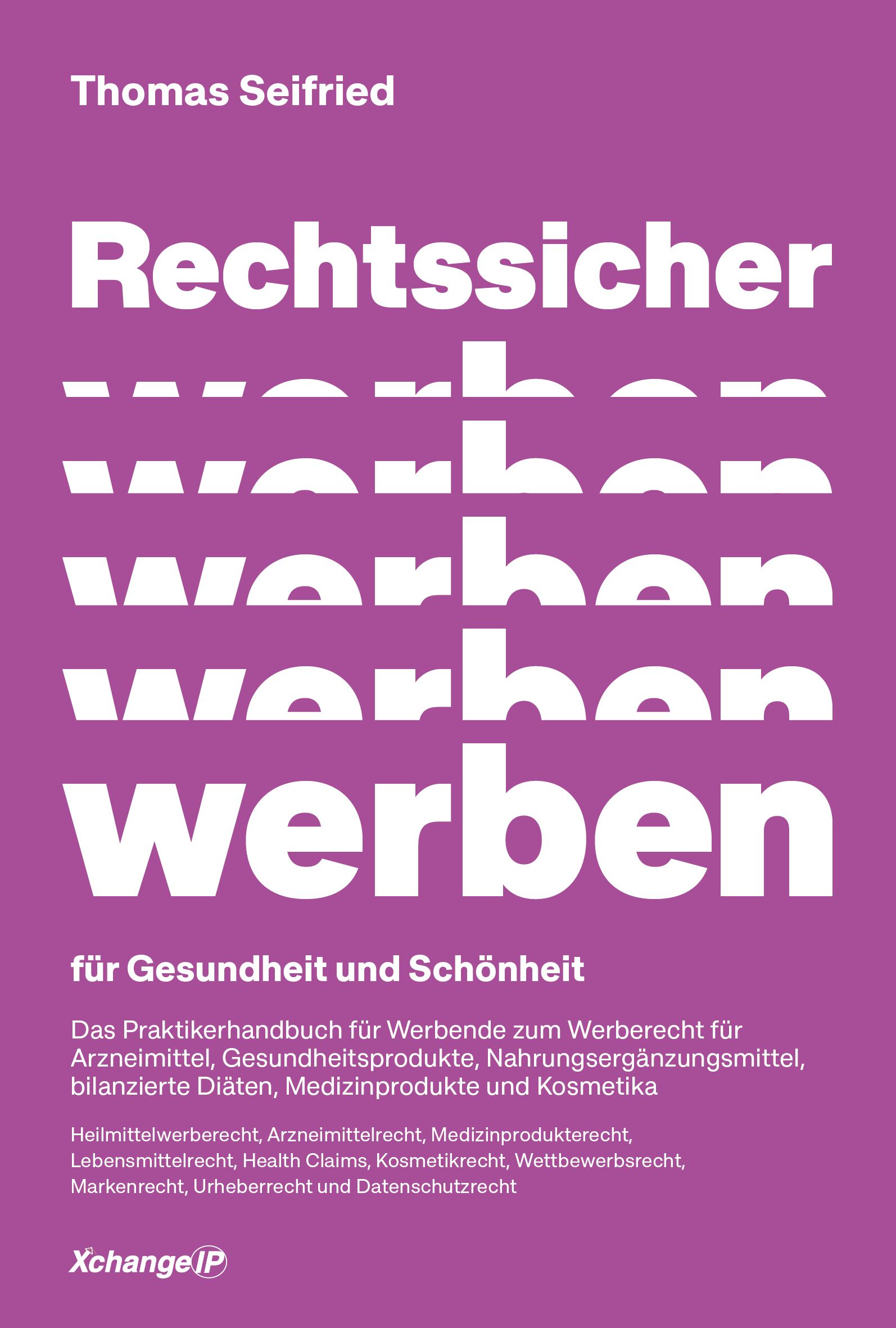
Advertising for health-related products is subject to particularly strict regulation. Courts set high standards for health-related claims. Misleading advertising is more the rule than the exception in this area. Advertising for medicinal products and other remedies, medical devices, food supplements, foods for special medical purposes and cosmetics is also restricted by specific laws and regulations. The risk of cease-and-desist notices and legal disputes is particularly high for these products. The reference book “Advertising for Health and Beauty with Legal Confidence” sets out the current legal position with reference to several hundred court decisions.
Back to table of contents
1st edition, November 2024, 408 pages, XchangeIP Verlag, available from bookshops or Amazon
ISBN 978-3-00-079406-3
The Health Claims Regulation (HCVO) framework
Principle: the Community list and individually authorised claims
Under the Health Claims Regulation (Article 3, sentence 1 NHCR), nutrition and health claims may be used on food labelling and in food advertising only if they comply with the Regulation.
Claims included in the Community list under Article 13 of the Health Claims Regulation are authorised
Health claims comply with the Health Claims Regulation if they do not breach Article 10. Under Article 10(1), health claims are prohibited unless they meet the general requirements in Chapter II and the specific requirements in Chapter IV of the Regulation, have been authorised under it and have been included in the Community list of authorised claims under Article 13 of the Regulation (“Community list”).
Claims individually authorised under Article 14 of the HCVO are also permitted
Claims included in the list of individually authorised claims under Article 14 of the HCVO also comply with the HCVO.
What is a “claim” within the meaning of the Health Claims Regulation?
Only claims about specific properties qualify as claims under the NHCR
Claims within the meaning of the HCVO (Art. 2(2) No. 1 HCVO) are statements that suggest a food has “special” properties. General descriptions such as “digestif” or “cough drop” are not covered (HCVO, Recital 5). Nor are statements about the general properties of a food or category of foods.
Examples from case law of “claims” within the meaning of the EU Health Claims Regulation
Claims about a particular property covered by the HCVO are
- calling a food supplement a “fat burner”. This gives the average consumer the impression that the food has the particular property of positively affecting fat burning (see OLG Koblenz, 30.6.2021 – 9 U 1268/20 – Fatburner);
- the term “easy to digest” in relation to wine and beer (Federal Court of Justice, 17 May 2018 – I ZR 252/16 – Bekömmliches Bier; inadmissible under Article 4(3) NHCR, which prohibits health claims for alcoholic beverages with an alcohol content above 1.2% by volume).
Examples from case law of statements that are not “claims” within the meaning of the EU Health Claims Regulation
General claims not covered by the HCVO include:
Conclusion: Not every statement is a claim under the HCVO. Rather, it must state that a food has a “particular property”.
What does “nutrition claim” mean under the Health Claims Regulation?
Positive nutritional properties
Under the HCVO, a nutrition claim is a claim that suggests a food has particular beneficial nutritional properties on account of
a) the amount of energy (calorific value) it provides, or
(b) the quantity of nutrients or other substances it contains (Article 2(2), No. 4 NHCR).
Example from case law of a nutrition claim under the HCVO
“Rich in salicin and flavonoids” is a nutrition claim. It refers to the ingredients in the food and, through the adjective “rich,” suggests a positive nutritional effect (OLG Frankfurt/M., 12.9.2019 – 6 U 114/18 – Anti-Hangover Drink).
Umbrella terms as “nutrition claims” under the HCVO
A “nutrition claim” within the meaning of Art. 2(2)(4)(b) of the Health Claims Regulation need not refer to specifically named substances. It may also use general terms. The Annex to the list of permitted nutrition claims under Art. 8(1) of the Health Claims Regulation itself includes general terms (e.g. “saturated fatty acids”, “fibre”, “protein”, “omega-3 fatty acids”, “monounsaturated fatty acids”, “polyunsaturated fatty acids”) (OLG Hamm, 4 August 2016 – 4 U 18/16 – Many vital nutrients).
Example from case law of an umbrella term for a nutrition claim within the meaning of the HCVO
“Vital nutrients” is a general nutrition claim. It refers to dietary fibre, vitamins, minerals and enzymes (Hamm Higher Regional Court, judgment of 4 Aug 2016 – 4 U 18/16 – Many Vital Nutrients).
What does “health-related” mean within the meaning of Article 2(2)(5) of the Health Claims Regulation?
“Health-related” refers to a claim promising an improvement in health
A health claim under the Health Claims Regulation suggests that a relationship exists between a food category, a food or one of its constituents on the one hand and health on the other (Art. 2(2)(5) of the Health Claims Regulation). According to the case law of the CJEU, the term “relationship” is to be interpreted broadly. It covers any relationship implying an improvement in health as a result of consuming the food (CJEU, 18 July 2013 – C-299/12 – Green Swan Pharmaceuticals; BGH, 10 December 2015 – I ZR 222/13 – Lernstark).
Statements about general well-being (“easy to digest”, “soothing”) are also “health claims” within the meaning of Article 2(2)(5) of the Health Claims Regulation (Regulation [EC] No 1924/2006), and therefore also violate competition law.
A statement about health and well-being is also a health claim if it falls within one of the categories listed in Article 13(1) or Article 14 of the HCVO. These categories include:
- Growth, development and bodily functions (see Art. 13(1)(a) HCVO), whereby bodily functions include all physiologically measurable processes of the human body that can be positively influenced (OLG Hamm, 2 July 2019 – I-4 U 142/18 – Elasten Trink Kur II; subsequently BGH, 14 May 2020 – I ZR 142/19 – Beauty Claims),
- psychological or behavioural functions, see Article 13(1)(b) HCVO (see BGH, 24 July 2014 – I ZR 221/12 – Original Bach-Blüten),
- Effects on slimming and body weight or on feelings of hunger or energy intake through food consumption, see Article 13(1)(c) HCVO,
These categories also include those listed in the Community list under Art. 13(III) HCVO.
Example, see Federal Court of Justice, judgment of 24 July 2014 – I ZR 221/12 – Original Bach Flowers: The statements “Zinc, vitamin C, E and biotin also help promote strong hair and/or healthy nails” and “The skin... is firmed all over the body” are health claims, because the Community list includes the claim that certain nutrients contribute to the maintenance of normal hair, skin and nails as a health claim.
A statement is “health-related” if it suggests that a food improves health.
Examples from case law of impermissible “health claims” under the HCVO
OLG Karlsruhe, 19.3.2024 – 14 U 63/23 – Babytraumtee:
The product name
“Baby Dream Tea”
Used together with an image of a woman holding a pregnancy test in her right hand and crossing the fingers of her left hand—a gesture intended to bring good luck—and the words “Before pregnancy”, the claim is an impermissible health claim under the Health Claims Regulation. The product name suggests that the product can positively influence conception. Improving the ability to conceive improves a person’s state of health.
OLG Celle, 3 February 2022 – 13 U 75/21 – Statements in an infomercial:
Statements in an infomercial
“So, instead of a Brigitte diet, try a V. diet. It not only tastes good, it’s really, really good for you, and the pounds come off—more like eight to ten kilos.”
“But what’s even better is that caffeine, with the right dosage and the right form of caffeine, takes away your appetite. So it doesn’t just take away the appetite signal you’re getting; it curbs your appetite altogether.”
“But it’s not just C., C., kudzu, passionflower, tryptophan—all of that. So if you can’t quit smoking with this, I don’t know what will.”
are prohibited under the Health Claims Regulation.
Higher Regional Court of Karlsruhe, judgment of 9 December 2022 – 4 U 225/22 – Rosehip capsules:
The claim
“For flexible joints”
is unlawful under the Health Claims Regulation when used in relation to rosehip capsules.
Higher Regional Court of Düsseldorf, judgment of 20 April 2023 – I-20 U 65/22 – Online advertising with health claims for a melatonin-containing food supplement:
The claim
“For everyone longing for gentle help to get a good night’s sleep”
in relation to a food supplement containing melatonin and passionflower violates the Health Claims Regulation (HCVO).
Higher Regional Court of Koblenz, 28 June 2023 – 9 U 1947/22 – Promotes sleep:
The notices
“promotes falling asleep” and “promotes staying asleep”
are impermissible health claims because they suggest that the advertised product could help improve the corresponding symptoms and thus a pathological condition in the form of sleep disorders.
OLG München, order of 21 November 2014 – 6 W 2103/14 – Natural Salt from the Dead Sea:
The claim used to advertise a sea salt:
“For thousands of years, the Dead Sea has been known for its healing and regenerative effects”
is an unlawful health claim within the meaning of Article 2(2)(5) of the Health Claims Regulation.
Difference between “nutrition claims” and “health claims” under the HCVO
Health claims under the HCVO
The HCVO distinguishes between nutrition and health claims, although there may be overlap (BGH, 12.2.2015 – I ZR 36/11 – Monsterbacke II; see also LG Hamburg, 15.11.2022 – 406 HKO 47/22 – permissibility of the term „vital“ in connection with a house brand). Health claims establish a link between a food or one of its components and health or wellbeing, while nutrition claims relate to the amount of nutrients, other substances or energy contained in a food (BGH, 12.2.2015 – I ZR 36/11 – Monsterbacke II).
Nutrition claims under the HCVO
Nutrition claims primarily include statements that relate directly to the energy provided by the food or to its constituents with a nutritional effect (BGH, 12.2.2015 – I ZR 36/11 – Monsterbacke II). Nutrition claims provide (only) factual information about a particular nutrient. Under Article 2(2)(4) of the HCVO, a statement is also a nutrition claim if it suggests that a food has particular beneficial nutritional properties. For this reason, a statement may be a nutrition claim if it evokes certain consumer associations concerning the energy provided by the food or a particular nutrient or substance it contains (BGH, 12.2.2015 – I ZR 36/11 – Monsterbacke II).
Case law example distinguishing between health claims and nutrition claims under the Health Claims Regulation
The slogan „As important as your daily glass of milk“ for a fruit quark is not a nutrition claim. It does not refer directly to the energy provided by the food or to its constituents with a nutritional effect, nor does it convey specific factual information about a particular nutrient. However, the slogan is a health claim, drawing on the widespread belief that children and young people should drink a glass of milk every day for its health benefits, particularly because of its mineral content. The slogan transfers this positive effect to the product, which is presented in this respect as being „equivalent to a daily glass of milk“. It thus suggests a link between the advertised food and the consumer’s health (BGH, 12.2.2015 – I ZR 36/11 – Monsterbacke II).
Cosmetic efficacy claims (“beauty claims”)
Beauty claims are often health claims too
Claims relating solely to beauty (“beauty claims”) are not health claims. In practice, however, such cases do not arise because claims about beauty, particularly in relation to skin and hair, are also included in the categories under Articles 13 and 14 HCVO and the Community list.
Case law example involving beauty claims
The claim
“Works from within. The Collagen Youth Drink, with 2500 mg of collagen and other highly effective active ingredients, improves the appearance of the skin by… reducing wrinkles”
is a specific health claim. The phrase “works from within” alone suggests to consumers that there is a connection between the collagen (or other “highly effective ingredients”) in the advertised product and the improved appearance of the skin resulting from fewer wrinkles. These words promise a physical effect. Consumers understand them to mean that the ingredients help reduce wrinkles. The claim suggests that beauty comes from within, that is, through an improvement in bodily processes (OLG Stuttgart, judgment of 4 November 2021 – 2 U 49/21, para. 53 – Collagen Youth Drink).
Authorised nutrition claims under the Annex to Article 8(1) of the Health Claims Regulation
Requirements for the permissibility of nutrition claims under the HCVO
Nutrition claims are permitted only if they are included in the Annex to the Nutrition and Health Claims Regulation (NHCR) and comply with it. The requirements set out in the Annex must also be met.
Example of a claim included in the HCVO that is impermissible because it exceeds the threshold
A cup-a-soup with a salt content of 0.6 g per 100 ml is advertised as
“lightly salted”
advertised. The claim “low in sodium/low in salt” in the Annex to Article 8 of the Nutrition and Health Claims Regulation (NHCR) is permitted only up to a limit of 0.12 g per 100 ml. For this reason alone, the claim was inadmissible (example: Federal Court of Justice, 18 May 2017 – I ZR 100/16 – Märchensuppe).
229 authorised health claims under the EU Health Claims Regulation
A prerequisite for permissibility is inclusion in the Community list under Article 13(3) of the HCVO
Under the Health Claims Regulation, health claims are permitted only if they have been included by the European Commission in the EU Register of permitted claims pursuant to Article 13(3) of the HCVO. This list currently contains 229 authorised claims and is set out in the Annex to Regulation No. 432/2012 of 16 May 2012.
Example: “Chloride”Under this list, the following claim is permitted for the nutrient “chloride”
“Chloride contributes to normal digestion through the production of stomach acid.”
The list specifies the following as a condition for using the claim:
“The claim may be used only for foods that meet the conditions for at least being a source of chloride, as listed in the Annex to Regulation (EC) No 1924/2006, under the claim [NAME OF VITAMIN(S)] AND/OR [NAME OF MINERAL/MINERAL SOURCE].”
As a restriction on use, the list states:
“This claim must not be used for chloride derived from sodium chloride.”
Claims about reducing disease risk under Article 14 HCVO are permitted only if individually authorised
Health claims within the meaning of Article 14 of the Health Claims Regulation (HCVO) concerning the reduction of disease risk, and claims about the beneficial effects of a food on children’s development and health, cannot be authorised by inclusion in the Community list under Article 13(3) HCVO. Instead, they must undergo an individual authorisation procedure under Articles 15 et seq. HCVO. Applications must be submitted via the European Commission’s E-Submission Food Chain (ESFC) platform. A list of the only seven claims authorised under Article 14 HCVO is set out in Annex I to Regulation (EU) No 957/2010.
A “claim referring to the reduction of a disease risk” is any claim that states, suggests or implies, directly or indirectly, that consuming a category of food, a food or one of its constituents significantly reduces a risk factor in the development of a human disease (see Article 2(2)(6) of the EU Health Claims Regulation). It is not necessary to expressly state that consuming a category of food, a food or one of its constituents significantly reduces a risk factor in the development of a human disease (CJEU, 18.7.2013 – C-299/12 – Green – Swan Pharmaceuticals; BGH, 10.12.2015 – I ZR 222/13 – Lernstark).
Pending claims (“pending claims”, “claims on hold”)
Pending claims/on hold claims and “botanicals”
Numerous claims pending before the Commission have not yet been approved because the scientific assessment is still ongoing (so-called “pending claims” or “claims on hold”).
This mainly concerns 1,549 claims about botanical substances, known as “botanicals”. Their assessment was deferred in 2010. A list of these Botanical Claims on hold is available as an Excel file, with the date of each application.
Example of a pending claim
One example of a pending claim is claim application No. 2636
"helps to induce calm rest and sleep”
for passionflower. Under Article 28(5) and (6) of the Health Claims Regulation, these claims may be used if they are scientifically substantiated. It must therefore be demonstrated that the substance in question actually has the claimed effect (Article 5(1)(a) of the Health Claims Regulation), that it is present in the user’s products in a relevant quantity (Article 5(1)(b) of the Health Claims Regulation), that it is bioavailable (Article 5(1)(c) of the Health Claims Regulation), and that it can produce the effect claimed by the user when consumed in a reasonably foreseeable amount (Article 5(1)(d) of the Health Claims Regulation) (Higher Regional Court of Koblenz, 28 June 2023 – 9 U 1947/22 – sleep-promoting). This applies both to the use of botanical claims as specific health claims under Article 10(1) of the Health Claims Regulation and to their use alongside references to general, non-specific health benefits under Article 10(3), where a specific health claim is included which, according to the Commission, is “on hold” and may continue to be used under Article 28(5) and (6). Claims not covered by Article 13(1)(a) or Article 14 of the Health Claims Regulation must have been submitted for authorisation before 19 January 2008 under Article 28(6)(b). This applies, for example, to claims relating to a psychological function under Article 13(1)(b).
Example
For “Crocus sativus L.” (saffron), the claims “contributes to emotional balance.”, “Helps to support the relaxation.” and “Helps to maintain a positive mood.” were submitted on 28 July 2008.
For this reason alone, a food supplement must not be advertised as “mood-enhancing saffron extract”, because the application was filed after 19.1.2008 (example: OLG Hamburg judgment of 2.6.2022 – 3 U 110/21 - Mood-enhancing saffron extract; reference to the CJEU pending following BGH v. 1.6.2023 - I ZR 109/22 – Botanicals).
Unsettled legal position on botanical claims
The case law has yet to clarify whether Article 10(1) or Article 10(3) of the Health Claims Regulation applies at all to botanicals that have not yet been assessed. Proceedings on this issue are pending before the Court of Justice of the European Union (reference to the CJEU pending, referred by the Federal Court of Justice on 1 Jun 2023 - I ZR 109/22 – Botanicals).
The Health Claims Regulation imposes a general ban on health claims for alcoholic beverages
Health claims are generally prohibited for beverages containing more than 1.2% alcohol by volume
Under Art. 4(3) HCVO, health claims for alcoholic beverages with an alcohol content of more than 1.2% by volume are generally prohibited.
Example of an unlawful health claim for beer and wine
The following advertising claim is prohibited under the Health Claims Regulation
“easy to drink”
for beers with an alcohol content of 5.1%, 2.9% and 4.4% (BGH, judgment of 17 May 2018 – I ZR 252/16 - Easy-Drinking Beer) and for a wine (CJEU, Third Chamber, judgment of 6. 9. 2012 – C-544/10 - Deutsches Weintor eG/Land Rheinland-Pfalz; see also BGH of 13.01.2011 - I ZR 22/09 - Gurktaler herbal liqueur).
Permissibility of specific health claims under Article 10(1) NHCR when included in the lists under Article 13 or Article 14 NHCR
Authorisation following inclusion in the lists under Article 13 or Article 14 HCVO
Under Article 10(1) HCVO, specific health claims are only permitted if they are included in the Community list of authorised claims under Article 13 (for general health claims) or individually authorised under Article 14 HCVO (for claims concerning the reduction of disease risk and children’s development and health).
Examples from case law of impermissible claims not included in the HCVO lists
- The advertising claim “Piperine (from black pepper), vitamin D3 and vitamin B6 are also included for a synergistic effect” is impermissible as a specific health claim within the meaning of Article 10(1) HCVO because it has not been included in the list of authorised claims under Articles 13 and 14 HCVO (Higher Regional Court of Koblenz, 28.6.2023 – 9 U 1947/22 – Promoting sleep).
- Advertising a product called “B. Stress” with an image of an intestinal loop and the claim“70 billion active & natural gut bacteria plus 10 billion Saccharomyces Boulardii”as a specific health claim within the meaning of Article 10(1) of the Health Claims Regulation is impermissible. No corresponding health claim is authorised, as all applications to authorise health claims relating to gut health for the bacterial strains in the product were rejected (Higher Regional Court of Munich, 31 October 2019 – 29 U 2177/19 – Gut Bacteria).
Using authorised health claims in paraphrased and colloquial forms
Courts permit the use of equivalent and colloquial claims
A health claim within the meaning of Article 10(1) HCVO is not permitted only when it matches an approved claim word for word. Equivalent claims may also be used (BGH. of 10.12.2015 – I ZR 222/13 – Lernstark). This includes colloquial wording, so that food businesses do not need to submit a separate authorisation application for every differently worded claim.
Examples from case law on the permitted and prohibited use of paraphrased and colloquial health claims
- Under Article 1 in conjunction with Annex I to Regulation (EU) No 957/2010, the following claim for the nutrient “iron” has been added to the list of permitted claims under Article 14(1) of the Health Claims Regulation: “Iron contributes to normal cognitive development in children.” This claim is equivalent to advertising a multivitamin juice with the words “With iron … to support concentration” and is therefore lawful (Federal Court of Justice, judgment of 10 Dec 2015 – I ZR 222/13 – Lernstark).
- The advertising claim “All natural – gentle sleep aids” is unlawful because it is not equivalent to the health claim authorised under the HCVO Community list, “Melatonin contributes to the reduction of time taken to fall asleep.” (OLG Düsseldorf, 20 April 2023 – I-20 U 65/22 – Online advertising making health claims for a melatonin-containing food supplement).
- For a food supplement containing vitamins C, D and B6 and zinc, the terms “healthy immune system” are not synonymous with “normal immune system” and are therefore unlawful. “Healthy” as opposed to “normal” suggests that the food supplement also has an effect when the consumer is not healthy (Munich Higher Regional Court, 21 Dec 2023 – 29 U 4088/22 – Healthy Immune System).
A health claim under the HCVO must relate to an ingredient
Referring to the food product as a whole is not permitted
Under Article 10(1) of the Health Claims Regulation, health claims must relate to the specific ingredient (nutrient, substance or food) for which they have been authorised under the Community list. They may not relate to the food product as a whole merely because it contains that ingredient. It must be clear which specific ingredient the claims relate to (Higher Regional Court of Celle, 6 September 2019 – 13 U 69/18 – Food advertising with health claims; Higher Regional Court of Hamburg, 2 March 2022 – 3 U 137/20 – Health-related advertising for joint capsules). Accordingly, a health claim for a product containing more than one substance is permissible only if it identifies the ingredient responsible for the claimed effect (Federal Court of Justice, 7 April 2016 – I ZR 81/15 – Repair Capsules).
Example from case law
The food supplement “A.® strong joint capsules” is a combination product containing glucosamine, chondroitin, vitamins C, D and K, and hyaluronic acid. The front label shown in the product advertisement displays the claims “Hyaluronic acid” and “with glucosamine, chondroitin and vitamins C and D”. It was advertised with the statement
“For stressed joints, to maintain mobility.”
This claim was already unlawful under the Health Claims Regulation because it was unclear which ingredient the claim referred to (Hamburg Higher Regional Court, judgment of 2 Mar 2022 – 3 U 137/20 – Health Claims for Joint Capsules).
Research resources and databases for the HCVO
European Union database
The European Commission provides a database in English and French of all authorised health claims. The database includes both authorised health claims listed in the Community list under Article 13(3) of the Health Claims Regulation and claims authorised individually under Article 14 et seq. It also includes health claims that have not been authorised.
Complete list of all Health Claims
A complete list of all claims authorised or refused authorisation under Article 13(1) or Article 14 HCVO can be downloaded in English from the European Commission’s website.
Legal risks and consequences of violations of the HCVO
Anyone who breaches the strict requirements of the HCVO when advertising food and food supplements risks serious legal and financial consequences. Even minor wording errors can prove costly.
Cease-and-desist notices from competitors
Competitors keep a particularly close eye on one another’s market conduct. Many have already been served with cease-and-desist letters themselves and are therefore alert to unlawful advertising for food supplements.
Cease-and-desist letters from qualified trade associations and qualified entities
Qualified trade associations (e.g. the Verband Sozialer Wettbewerb e.V. or Wettbewerbszentrale) and qualified entities may also issue cease-and-desist notices under competition law. These associations often take action on the basis of information provided by their members.
Legal action
Unsuccessful cease-and-desist letters are often followed by court proceedings, usually in the form of preliminary injunction proceedings.
Fines or imprisonment
Finally, unlawful advertising can also result in prison sentences of up to one year or fines. The relevant provisions of the German Food and Feed Code (LFGB) prescribe criminal penalties for breaches of the Health Claims Regulation (§ 59 Abs. 2 Nr. 3 und Nr. 10 LFGB).
Our legal services for the Health Claims Regulation (HCVO)
Assessment under the HCVO and legal enforcement of your interests
- Review of permissible health claims
- Review of claims made by competitors
- Competition-law warning letters demanding undertakings to cease and desist backed by contractual penalties, sent to competitors over unauthorised health claims
- Enforcing the law against unlawful health claims, particularly in interim injunction proceedings
Author: Thomas Seifried, Lawyer specialising in medicinal product advertising law and Specialist lawyer for intellectual property law
Received a cease-and-desist letter for violating the Health Claims Regulation?
Send us your cease-and-desist letter for a free initial assessment of your case.
Competitors and associations often take action against HCVO violations, challenging them by sending a cease-and-desist letter under competition law and demanding a cease-and-desist undertaking backed by a contractual penalty. These cases are generally pursued in court by way of an interim injunction. Every detail matters. Contact us.
What should companies do after receiving a cease-and-desist letter for violations of the HCVO?
If you receive a cease-and-desist letter alleging a violation of the Health Claims Regulation, the following steps are recommended:
1. Note the deadlines in the cease-and-desist letter. Do not wait until the deadline expires; act immediately.
A short deadline of just one week is often set for submitting a cease-and-desist undertaking backed by a contractual penalty. Failure to respond in time may result in court proceedings for an interim injunction. Don’t wait until the deadline expires—seek advice from a competition law lawyer immediately.
2. Document alleged breaches of the HCVO
Keep copies of all challenged advertising materials, webpages, social media posts and product images. Provide information about the environmental claim in question and any sustainability labels used, in particular the certification requirements.
3. Don’t sign a cease-and-desist undertaking prematurely
The attached cease-and-desist undertaking backed by a contractual penalty serves the interests of the sender. It is often too broadly worded. This alone may make it an abusive cease-and-desist letter. Whether it should be signed in this form requires careful legal review.
4. Have the prospects of legal success assessed
Not every cease-and-desist letter alleging violations of the Health Claims Regulation is justified. In particular, the following should be examined
- the standing of the party issuing the cease-and-desist notice,
- standing to be sued
- whether the alleged unfair competition violation has occurred,
- the scope of the claims for injunctive relief and
- the amount of the claimed costs of the cease-and-desist notice.
Send us your cease-and-desist letter for a free initial assessment of your case.
Your lawyer for the Health Claims Regulation (HCVO) - Thomas Seifried, specialist lawyer for intellectual property law
Competition lawyer Thomas Seifried has over 20 years’ experience in competition law, with numerous proven successes, and has also been a specialist lawyer for intellectual property law since 2007. He advises and represents companies in the healthcare and cosmetics sectors, as well as manufacturers of food supplements.