


Pharmaceutical Advertising - The legal rules, with a free initial assessment of your case
When is a product a medicinal product within the meaning of Section 2 of the Medicinal Products Act (AMG)?
The law governing medicinal product advertising relies on pharmaceutical law for the definition of a medicinal product: under Section 1 HWG, the German Medicines Advertising Act applies to advertising for medicinal products within the meaning of Section 2 of the German Medicinal Products Act (AMG). Whether a product is classified as a medicinal product is determined under Section 2 AMG. The term “medicinal product” is to be interpreted broadly (BGH, order of 18 October 2012 – I ZR 38/12 – functional medicinal products). Section 2(1)(1) AMG covers medicinal products by presentation, while Section 2(1)(2)(a) covers medicinal products by function.
Unlawful advertising for medicinal products is often challenged by a cease-and-desist letter under competition law or by an application for an interim injunction.
Medicines by presentation
Presentation medicinal products (medicinal products by presentation) are, under Section 2(1) No. 1 AMG, products presented as having properties for curing or alleviating human diseases or pathological complaints, or for preventing them. Whether a product has any kind of effect is irrelevant to its classification as a presentation medicinal product (OLG Frankfurt, judgment of 29.04.2008 - 6 U 109/07 - Mouthwash). It is sufficient that, based on its packaging and the product information provided, an average consumer who is reasonably well-informed and reasonably observant and circumspect would regard it as a medicinal product.
Medicinal products by function
Functional medicinal products are referred to in Section 2(1) No. 2(a) of the Medicinal Products Act. Whether a product is a functional medicinal product depends solely on how it works (OLG Frankfurt, judgment of 29.04.2008 - 6 U 109/07 - Mouthwash). The mere fact that a substance has a pharmacological effect does not, however, make a presentation medicinal product a functional medicinal product. A product qualifies as a functional medicinal product only if its pharmacological effect can be established and it has a significant effect on human physiological functions; see BGH, judgment of 25.06.2015 – I ZR 11/14 - Mouthwash Not a Functional Medicinal Product (Chlorhexidine).
According to case law, when determining whether a product falls within the definition of a functional medicinal product, all its characteristics must be taken into account, in particular its composition, pharmacological properties, conditions of use, extent of distribution, familiarity to consumers, and the risks its use may entail (CJEU, judgment of 9.6.2005 - C-211/03 - HLH Warenvertriebs GmbH; BGH, judgment of 14.01.2010 - I ZR 138/07 - Cinnamon Preparations; CJEU, judgment of 15.11.2007 - C-319/05 Commission v Germany, Garlic Extract Powder Capsules). The product’s pharmacological properties are the factor on the basis of which it must be assessed whether the product can be used in or on the human body to establish a medical diagnosis or to restore, improve or modify human physiological functions (CJEU, judgment of 30.4.2009 – C-27/08 – BIOS Naturprodukte/Saarland, with further references).
Essential for pharmacists and drugstore operators:
“Advertising for Health and Beauty with Legal Certainty”
The practical guide to medicines advertising law and advertising for food supplements, health claims, foods for special medical purposes, medical devices and cosmetics – available from bookshops or Amazon
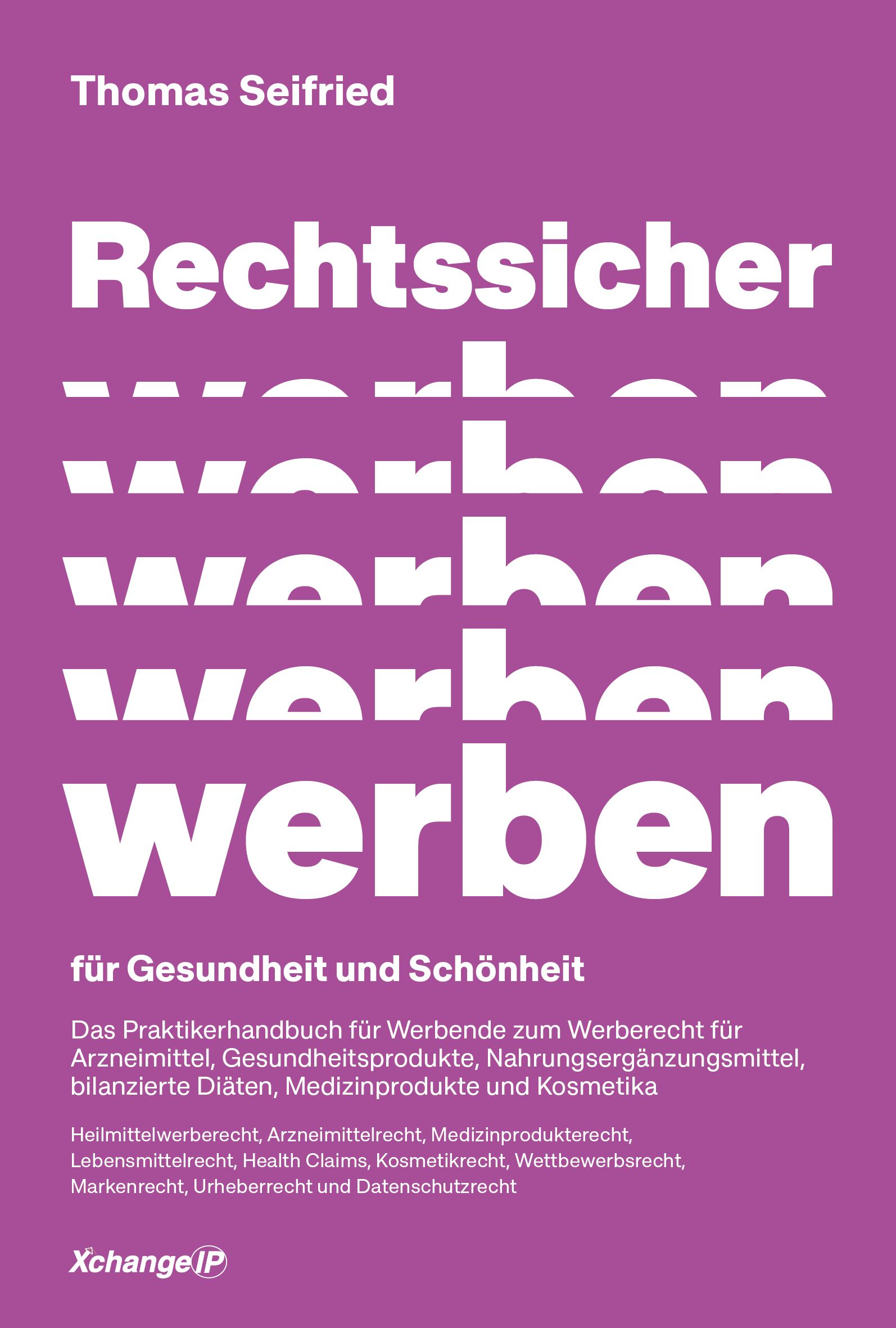
Advertising for health-related products is subject to particularly extensive regulation. Case law imposes strict requirements on health-related claims. Advertising for medicines and other remedies, medical devices, food supplements, foods for special medical purposes and cosmetics is also restricted by specific laws and regulations. The risk of cease-and-desist letters and legal disputes is particularly high for these products. This book sets out the current law through several hundred examples from case law.
Contents:
- Selection of terms, texts and media
- Advertising with Trademarks
- General principles of competition law, misleading and comparative advertising, advertising with prices and discounts
- Search engine optimisation and search engine advertising, social media and influencer marketing
- General requirements for health-related advertising
- Prohibitions and restrictions under medicines advertising law
- Advertising for medicinal products, pharmaceutical price controls, and advertising discounts and benefits
- Advertising medical devices
- Advertising food supplements, especially HEALTH CLAIMS
- Advertising for foods for special medical purposes
- Advertising for cosmetic products
Back to table of contents
1st edition, November 2024, 408 pages, XchangeIP Verlag, available from bookshops or Amazon
ISBN 978-3-00-079406-3
Advertising bans for medicinal products that require authorisation but are not authorised, under Section 3a HWG
Medicinal products requiring authorization
As a general rule, advertising is prohibited under Section 3a HWG for medicinal products that require authorization but have not been authorized, regardless of whether the advertising is directed at consumers or professionals. Finished medicinal products offered or sold in Germany require authorization (Section 21(1) AMG). Under the statutory definition in Section 4(1) AMG, finished medicinal products are products manufactured or prepared in advance using an industrial process and placed on the market in packaging intended for supply to consumers; they are not manufactured in pharmacies. Intermediate products intended for further processing by a manufacturer are not finished medicinal products.
Medicinal products not subject to a statutory marketing authorisation requirement
However, the advertising ban under § 3a HWG applies only to medicinal products that require authorisation. The law exempts certain medicinal products from the authorisation requirement (§ 21(2) AMG). The advertising ban does not apply to such products (BGH, judgment of 9 February 2017 – I ZR 130/13 – Weihrauch-Extrakt-Kapseln II). Medicinal products that are not prepared commercially and whose preparation involves a manual rather than an industrial process are not subject to authorisation (see Article 2(1) Directive 2001/83/EC, CJEU, 26 October 2016 – C-276/15 – Hecht-Pharma/Hohenzollern Apotheke). This initially concerns products made by pharmacies (§ 21(2)(2) AMG), namely extemporaneous preparations under § 1a(8) ApBetrO and extemporaneous preparations that may be made in larger quantities as stock preparations under § 21(2)(1) AMG.
Official determination that no marketing authorisation is required
A regulatory determination that a product is exempt from authorisation is binding on the courts. This also applies if the BfArM’s determination is flawed, provided it is not void. A determination is void only if it is wholly intolerable, that is, incompatible with fundamental constitutional principles or essential values inherent in the legal system. The very purpose of this binding effect is to ensure that the specialist administrative authority makes a final decision that the civil courts cannot review, even if it is unlawful (Higher Regional Court of Frankfurt am Main, judgment of 8 July 2021 – 6 U 126/20 – Sale of cough syrup as a medical device permitted despite being presented as a medicinal product).
Violations of statutory advertising bans constitute unfair commercial practices.
Distinguishing finished medicinal products requiring authorization from extemporaneous medicinal products exempt from authorization
Manufacturing without marketing authorisation and the corresponding sale on the basis of a formula require that the product actually be made to an individual formula and that the pharmacist carry out the key manufacturing steps themselves. A product that does not differ from the bulk product supplied to the pharmacist and is merely divided and portioned is not covered by the pharmacy exemption and is a finished medicinal product, even if excipients are added to make portioning easier (BGH, 23 June 2005 – I ZR 194/02 – Breath Test I; subsequently OLG Düsseldorf, 20 March 2012 – I-20 U 108/11 – Breath Test). The Federal Institute for Drugs and Medical Devices subsequently ruled by declaratory decision that the 13C-urea breath test was not a medicinal product requiring marketing authorisation; see BGH, 24 September 2013 – I ZR 73/12 – Breath Test II.
Further exemptions from the authorisation requirement
Other medicinal products not requiring marketing authorisation
Prohibition on advertising medicinal products not authorized as such under Section 3a HWG
Under Section 3a HWG, advertising for medicinal products that require authorisation is prohibited if they have not been authorised under pharmaceutical law or are not deemed to be authorised. This advertising ban also applies when the product is promoted for an indication not covered by its authorisation (Section 3a, sentence 2 HWG).
Example: A homeopathic medicinal product made from medicinal plants such as echinacea, chamomile, elderberry and tormentil is authorised for the indication “relief of symptoms of middle ear infections and the common cold”. According to its product information, it has an “acute dosage”. The medicine was advertised with the claims “First aid for middle ear infections/earache”, “… relieves pain quickly”, “… has been helping for generations”, “… 67% fewer antibiotics” and “… has anti-inflammatory/pain-relieving effects”. This was misleading under Section 3 of the German Medicines Advertising Act (HWG) and unlawful under Section 3a, sentence 2 of the HWG. First, in the context of the product information, “acute” meant only the opposite of “chronic”. In addition, “first aid” suggests pain relief in emergency situations. The medicine was not authorised for this, nor was it authorised for use to treat earache (Higher Regional Court of Munich, judgment of 24 February 2022 – 29 U 7517/20 – First aid for earache).
The prohibition is breached not only when advertising explicitly refers to an indication not covered by the marketing authorisation, but also when it uses a broader term that extends beyond the approved therapeutic indication (Federal Court of Justice, judgment of 13 March 2008 – I ZR 95/05 – Amlodipin).
Example: A prescription medicine is authorised for the indications “chronic stable angina pectoris (effort angina) and vasospastic angina pectoris (Prinzmetal’s angina, variant angina)”, but not for the treatment of unstable angina pectoris. The medicine was advertised with the claim “Medicine for the treatment of high blood pressure and angina pectoris”. This was unlawful. The umbrella term “angina pectoris” also includes unstable angina pectoris, for which the medicine is not authorised (Federal Court of Justice, judgment of 13 March 2008 – I ZR 95/05 – Amlodipine).
Example: A homeopathic medicinal product is authorized for the indication “rheumatic pain in bones, periosteum, joints, tendons and muscles, as well as the effects of injuries and overexertion.” It was advertised with the statements “The all-rounder for pain” and “I still can’t believe my pain is just gone.” This was unlawful because the statements were not limited to the indication “rheumatic pain” (OLG Munich, judgment of 19.9.2019 – 6 U 467/19 - All-Rounder).
It is also unlawful to advertise specific indications under a broadly worded indication if they do not readily follow from the basic indication.
Example: A medicinal product has a so-called subsequent authorisation under § 109a(3) AMG as a traditional medicinal product “for improving general well-being”. It was advertised as “Mental Fitness”. This was impermissible because the authorisation related only to a general indication, and an effect on mental fitness was not covered by that basic indication (Higher Regional Court of Cologne, judgment of 8.5.2009 - 6 U 233/08 - Mental Fitness).
By contrast, advertising may refer to (additional) effects of the medicine that are causally related to its authorised indication, provided that the advertisement makes this connection clear and shows that there is no separate indication, so that consumers understand the disputed claim only as a statement about an effect and not as a reference to an indication (Regional Court of Düsseldorf, judgment of 10 October 2022 – 37 O 41/21).
However, the advertising ban under § 3a HWG does not apply to a medicine that, pursuant to § 21(2), No. 1 AMG, is prepared in a pharmacy during the usual course of business, in its essential manufacturing steps, in quantities of up to one hundred ready-for-sale packs per day (BGH, judgment of 9 February 2017 – I ZR 130/13 – Frankincense extract capsules II).
Advertising ban on indications for registered homeopathic medicinal products or those exempt from registration under § 5 HWG
Prohibition on advertising indications for registered homeopathic medicinal products
Due to the high dilution, it is not possible to demonstrate the efficacy of homeopathic medicinal products. Accordingly, under Section 5 HWG, advertising registered homeopathic medicinal products for a particular indication is generally prohibited, both to healthcare professionals and to consumers. Indications may not be advertised for homeopathic medicinal products that are not authorised but are merely registered or exempt from registration. Under the definition in Section 26(26) of the German Medicinal Products Act (AMG), a homeopathic medicinal product is a medicinal product manufactured using a homeopathic preparation method described in the European Pharmacopoeia or, where no such method is available, in the officially recognised pharmacopoeias of EU Member States. Case law has held that the way a product is advertised may also indicate that it is a homeopathic medicinal product. Examples include the word “Globuli”, the stated active ingredient (in the “C 30” and “HCG” cases), an image of a typical medicine bottle with a screw cap, and a comparatively high price (in this case, a 20 g pack for €31.90 and a 100 g pack for €139.90; Berlin Court of Appeal, judgment of 18 September 2018 – 5 U 15/17 – Unlawful advertising for a homeopathic medicinal product).
No advertising ban for authorised homeopathic medicinal products
However, this advertising ban applies only to registered homeopathic medicinal products, not to approved homeopathic medicinal products. Approved homeopathic medicinal products may therefore be advertised with an indication, and their approval is evidence of efficacy in legal proceedings (see above). However, advertising for approved homeopathic medicinal products is misleading if it goes beyond the approved indication.
Ban on advertising in package leaflets under § 4a HWG
Section 4a(1) HWG prohibits advertising other medicinal products or other products in a medicinal product’s package leaflet. The mandatory information required in package leaflets under Section 11(1) AMG is not advertising within the meaning of the law governing the advertising of medicinal products, since that law cannot prohibit information required under Sections 10 and 11 AMG.
Ban on advertising prescription-only medicinal products to the general public under § 10(1) HWG
What is “advertising prescription-only medicines”?
The courts take a strict approach: advertising prescription-only medicinal products does not require the advertiser to be acting to promote sales of its own products. It is sufficient for a third party, such as a journalist, to disseminate information about a medicinal product, in particular its curative or preventive properties, where that third party acts on their own initiative and in complete independence—both legally and factually—from the manufacturer or seller (CJEU, judgment of 2 April 2009 - C-421/07; OLG Frankfurt a. M., judgment of 6 March 2025 – 6 U 74/24 - Medical Cannabis).
Prescription-only medicinal products
Advertising for prescription medicines may be directed only at a specialist audience. This applies to advertising for prescription medicines and medicines containing psychotropic substances that carry a risk of dependence. Whether a medicine requires a prescription is governed by § 48 AMG in conjunction with § 1 AmVV. Prescription medicines also include pharmacy-prepared medicines, i.e. medicines made in advance as part of the normal operation of a pharmacy, on a single day, in up to one hundred ready-to-dispense packs or an equivalent quantity; and compounded medicines, i.e. medicines made in a pharmacy to an individual prescription and formulation (OLG Stuttgart, judgment of 27 September 2018 – 2 U 41/18 – Unlawful advertising for prescription medicines through product advertising in domain names and on a website. The subsequent appeal against refusal of leave to appeal was dismissed by the BGH in case I ZR 181/18).
Medical cannabis as a prescription-only medicinal product
Medical cannabis is also available only on prescription (§ 3 Medical Cannabis Act - MedCanG). The operator of an online platform that arranges treatment with medical cannabis therefore breaches the prohibition under medicinal products advertising law on advertising prescription-only medicinal products to the general public if it enables users to request treatment from cooperating doctors by referring to conditions treatable with medical cannabis (BGH, judgment of 26 March 2026 - I ZR 74/25 - Advertising medical treatment with medical cannabis).
The specialist audience
Prescription-only medicinal products may not be advertised to the general public (laypeople). This is intended to prevent people from treating themselves with medication. Advertising prescription-only medicinal products to non-specialist professional audiences is also prohibited. Such products may only be advertised to a restricted professional audience. This audience is narrower than the “professional circles” defined in § 2 HWG. The restricted audience under § 10 HWG expressly consists only of doctors, dentists, veterinarians, pharmacists and persons legally entitled to trade in these medicinal products (pharmacists, pharmaceutical wholesalers and pharmaceutical companies). Alternative practitioners, dental practitioners and non-medical psychotherapists are not part of this restricted audience, nor are druggists, health-food store owners or retailers who are not pharmacists.
Ban on advertising medicinal products containing psychotropic substances with a risk of dependence
Advertising medicinal products containing psychotropic active ingredients that carry a risk of dependence is also prohibited outside specialist professional circles. This advertising ban also applies to sleeping pills, psychotropic medicines and emergency contraceptives (e.g. the “morning-after pill”), under Section 10(2) HWG.
Ban on advertising medicinal products to the general public (laypeople) under § 11 of the German Medicinal Products Advertising Act
Principles
Advertising for medicinal products to the general public—that is, consumers who are not healthcare professionals—is restricted. Section 11 of the German Medicines Advertising Act (HWG) sets out several restrictions on advertising remedies to the general public (see above). Some provisions of Section 11 HWG apply only to medicinal products.
Statutory definition of professional circles
Under Section 2 HWG, “professional circles” means
“Members of the healthcare professions or healthcare trades, institutions serving human or animal health, or other persons, insofar as they lawfully trade in medicines, medical devices, procedures, treatments, products or other means, or use them in the course of their profession.”
Healthcare professionals include doctors, dentists, psychological psychotherapists, alternative practitioners and members of the healthcare professions (Regional Court of Ulm, 17 December 2012 – 10 O 90/12 – Indications), such as nursing staff. Those permitted to trade in medicinal products as part of their profession include pharmacists, wholesalers and pharmaceutical companies. Drugstore operators and other retailers may also trade in medicinal products, but only in non-pharmacy medicines. People who use medicinal products in the course of their profession are also considered healthcare professionals, including beauticians and opticians. Patients are not healthcare professionals, even if they have a chronic illness (Higher Regional Court of Stuttgart, 12 November 1999 – 2 U 82/99 – Unfair competition through depiction of diagnostic and treatment procedures in a rehabilitation clinic brochure).
Advertising medicinal products with celebrity endorsements and influencer marketing for medicinal products under Section 11(1), No. 2 of the HWG
Under Section 11(1)(2) HWG, celebrity endorsements of medicinal products to consumers are prohibited if the celebrity’s fame could encourage people to use the product. Celebrities serve as role models. The ban on using celebrities in advertising to consumers is intended to prevent people from buying medicines impulsively and without due care, based on emotion. However, not all celebrity advertising is prohibited—only advertising in which the celebrity makes an endorsement. A further requirement is that the person’s fame could encourage use of the medicinal product. The key question is whether the celebrity adopts a role in the advertisement or whether the advertising suggests that they personally stand behind the claim. It is impermissible for advertising to suggest that the celebrity personally endorses the message.
Example: An advertisement for Schüssler salts featured a well-known actress. The advertising copy read:
“I am responsible for balancing work and family life—and for my health, too - [Name der Schauspielerin], mother, actress and entrepreneur”
This was an unlawful celebrity endorsement. The advertising suggested that the actress personally stood behind the advertising message as a “mother, actress and entrepreneur”.
A specific instruction to take action is not required for an endorsement by a celebrity (Higher Regional Court of Karlsruhe, judgment of 8.4.2015 – 6 U 66/13 - Impermissible advertising of medicinal products using an endorsement by a prominent actress). This criterion will generally be met by influencers, as they imply that they personally stand behind the product. Influencers who have gained a certain level of recognition must therefore not advertise medicinal products.
Other restrictions on advertising medicinal products to the general public (laypersons) under Section 11 HWG
Ban on comparative advertising for medicinal products under § 11(2) HWG (claims of equivalent efficacy)
Claims of equipotency
Advertising medicinal products to the general public that compares them with one another and claims that one product has at least the same efficacy (equipotency) as another is prohibited. The reference product must be identifiable. This requirement is not met by a claim of superiority (“works best”) or a claim that the product is among the top performers (“none works better”). Such claims do not violate Section 11(2) HWG (see OLG Düsseldorf, 10 November 2016 – 20 U 55/16 – “No One Is Faster”) and are permissible if accurate.
This prohibition also applies when the advertisement refers to an active ingredient and consumers associate that ingredient with medicines (Higher Regional Court of Cologne, 1 April 2011 – 6 U 214/10 – “Modern medicine relies on…”).
Equivalence claims for medicinal products are permitted when directed at healthcare professionals (see below). The general principles governing comparative advertising still apply.
Prohibition on claims of equivalence addressed to the general (lay) public
Medicines may not be advertised to the general public (consumers) using claims that suggest the medicine’s effect is equivalent or superior to that of another medicine or treatment. Section 11(2) of the German Medicines Advertising Act specifically regulates comparative advertising of medicines under competition law.
Claims of therapeutic equivalence to healthcare professionals
Claims of therapeutic equivalence are permitted in advertising to healthcare professionals. Whether advertising that compares efficacy is permissible depends above all on whether the claim is supported by scientific evidence. If a claim that an advertised medicinal product (biosimilar) has comparable efficacy to the reference product is accompanied by a footnote citing a scientific study, healthcare professionals expect this to be a clinical efficacy study, not a clinical pharmacology study involving healthy volunteers (Higher Regional Court of Hamburg, judgment of 2 October 2014 – 3 U 17/13 – Misleading advertising for a biosimilar medicinal product).
Claims of equivalent potency in product information
In practice, the most relevant cases involve advertising claims comparing effects with statements in the product information, or efficacy comparisons made in the product information itself.
Ban under Section 12 HWG on advertising certain medicinal products to the general public (consumers)
Under Section 12 HWG, advertising medicinal products to the general public is prohibited if it relates to the diagnosis, prevention, elimination or relief of particularly dangerous diseases. These diseases and conditions are listed in Annex A to Section 12 HWG:1. Diseases that must be reported under the Infection Protection Act of 20 July 2000, or infections caused by pathogens that must be reported. The reference to the Infection Protection Act of 20 July 2000 is dynamic and also covers later versions of the Act. COVID-19 is therefore a reportable disease, even though SARS-CoV-2 viruses were not added to the list of pathogens that must be reported until 2020 (Federal Court of Justice, 21 December 2023 – I ZR 24/23 – Corona Prophylaxis); 2. Malignant neoplasms,3. Addictive disorders, except nicotine dependence,4. Pathological complications of pregnancy, childbirth and the puerperium.
Misleading advertising for medicines under medicines advertising law
No scientifically substantiated effect under Section 3, sentence 2, no. 1 HWG
Medicinal products are subject to the prohibition on misleading advertising under § 3 sentence 2 No. 1 HWG. Breaches of the prohibitions on misleading advertising under medicinal products advertising law constitute misleading advertising under competition law. This prohibition essentially codifies what the courts already require of health-related advertising. Advertising is misleading if it attributes effects to medicinal products that they do not have. As with health-related advertising generally, particularly strict requirements apply to the accuracy, unambiguity and clarity of advertising claims (Federal Court of Justice, judgment of 6.2.2013 – I ZR 62/11 - Basal insulin with a weight advantage).
Scientifically established efficacy for medicinal products requiring marketing authorisation
Under the “strict standard” principle, health-related advertising is permitted only if it is supported by established scientific evidence. For medicinal products subject to authorisation, registration is an indication that the product is consistent with established scientific knowledge. Claims that match the wording or meaning of the medicinal product’s authorisation are presumed to reflect the established state of scientific knowledge at the time of authorisation, including as to the stated therapeutic efficacy. Such claims appear in the product information (BGH, judgment of 6 February 2013 – I ZR 62/11 - Basisinsulin mit Gewichtsvorteil), which must be submitted with an application for authorisation of a medicinal product. However, this indication can be rebutted if scientific findings that emerged after authorisation, or were otherwise unavailable to the authorising authority when it made its decision, call into question the scientific validity of the claims supported by the authorisation (BGH, judgment of 7 May 2015 – I ZR 29/14 - Äquipotenzangabe in Fachinformation).
No scientifically established efficacy for traditional herbal medicinal products
This principle does not apply to traditionally registered herbal medicinal products under Section 39a AMG. There are differences between the authorisation of a medicinal product and the registration of a traditional herbal medicinal product. Although the same submission format is used, registration of a traditional herbal medicinal product does not require a complete dossier; in particular, efficacy does not have to be demonstrated through product-specific clinical trials. Essentially, only bibliographic evidence must be submitted to show that the medicinal product has been in medical use for at least 30 years and that its efficacy is plausible and it is safe based on long-standing experience (Section 39a(1), Nos. 4 and 5 AMG; Higher Regional Court of Jena, judgment of 3 July 2019 – 2 U 626/18 – Strengthens the immune system).
Misleading medicinal product names under pharmaceutical law
Misleading medicinal product names under Section 8 AMG
The manufacture or marketing of medicinal products with misleading names is prohibited under Section 8 of the German Medicines Act (AMG). Marketing also includes advertising (see Section 4(17) AMG). Given the importance of protecting health and the health risks associated with false expectations about medicinal products, names of medicinal products must be especially truthful, unambiguous and clear under the “strict principle” (OVG Münster, judgment of 17 June 2013 – 13 A 1113/11; BGH, 6 February 2013 – I ZR 62/11 – Basal Insulin with Weight Benefit).
Misleading medicinal product names under an umbrella-brand strategy
For product names or designations made up of several components, consumers usually attach particular importance to the main component—typically the first part of the name—when it comes to the product’s type or quality. If the main component of a multi-part designation is a house mark that has been used for certain medicines for several years, consumers familiar with a product under that mark may assume that a (new) medicine bearing the same main designation has at least a similar area of use and therapeutic efficacy, and may therefore be misled. Example (OVG Münster, judgment of 17 June 2013 – 13 A 1113/11; see also OLG Frankfurt, 22 May 2020 – 6 U 23/20 – Medicines by presentation) A manufacturer has marketed various dermatological medicines under a single house mark for decades. The house mark forms the first part of each product name. The sole active ingredient in these products is an antihistamine. The manufacturer also markets a medicinal cream for cold sores whose sole active ingredient is the antiviral agent penciclovir. The Federal Institute for Drugs and Medical Devices (BfArM) rejected use of the house mark for this product, finding that using the same house mark for a product with a different active ingredient would be misleading. A significant proportion of consumers would assume, based on the main designation (the house mark), that the new medicine had therapeutic effects at least similar to those of the other antihistamine products. In fact, however, no such similarity exists. Whereas the house-mark products used to treat allergic reactions contain an antihistamine as their active ingredient, the cold sore cream contains only the antiviral agent penciclovir.
Mandatory information for medicinal products under § 4 of the German Medicines Advertising Act (HWG)
General mandatory information for advertising medicinal products
Under Section 4 HWG, all advertising for medicinal products directed at healthcare professionals or the general public must include the following information, clearly separated from the other advertising claims and easy to read:
- the name of the medicinal product,
- the indications for use,
- Warnings, insofar as required for the labelling of containers and outer packaging,
Mandatory notice that a prescription is required
Under § 4 Abs. 1 Nr. 7a HWG, medicinal products available only on prescription under § 48 AMG must also carry the notice “prescription only”.
Mandatory information in advertising for traditional herbal medicinal products
Advertising for a traditional herbal medicinal product registered under the German Medicinal Products Act must include the following statement under Section 2(1), sentence 2 of the German Act on the Advertising of Medicinal Products (HWG):
“Traditional herbal medicinal product for use in ... (specified indication(s)) exclusively on the basis of long-standing use”.
Mandatory information in advertising for single-ingredient medicinal products under Section 4(1a) HWG
For medicinal products containing only one active substance (“single-ingredient products”), the name of that substance must be included in the medicinal product’s name, together with the wording
“Active ingredient: ...”
apply. An exception applies if the name of the medicinal product already includes the name of the active ingredient.
Mandatory information for consumer advertising
In advertising outside professional circles (to consumers), the text
“For risks and side effects, read the package leaflet and ask your doctor or pharmacist”
must be stated in a clearly legible manner and clearly separated and distinguished from the other advertising statements (Section 4(4) HWG). This notice should appear in a font size of at least 6 points (Federal Court of Justice, 10 December 1986 – I ZR 213/84 – 6-point font; Higher Regional Court of Cologne, 1 July 2016 – 6 U 151/15 – inadmissibility of offering gift cards with the purchase of medical devices).
Mandatory information in advertising for medicinal products in audiovisual media (television, YouTube)
The mandatory information under Section 4(1) HWG does not have to be shown in films or on television. Instead, the following text must be displayed and spoken:
“For risks and side effects, read the package leaflet and ask your doctor or pharmacist”
Advertising for medicinal waters must include the following mandatory text:
"Read the label and ask your doctor or pharmacist about risks and side effects"
This applies to prescription-only medicinal products and to non-prescription medicinal products if the package leaflet or packaging lists side effects or risks (Section 4(3), sentence 4 HWG).
Additional mandatory information for advertising to healthcare professionals
Advertising directed at healthcare professionals must include additional information required by law. The advertiser must also state:
- the name or business name and registered office of the pharmaceutical entrepreneur,
- the composition of the medicinal product in accordance with Section 11(1), sentence 1, no. 6(d) of the German Medicinal Products Act,
- the contraindications,
- the side effects
This mandatory information for advertising to consumers and healthcare professionals must match the information required for the package leaflet.
Exception: Reminder advertising
Reminder advertising does not have to include the mandatory information listed above under Section 4(6) HWG. It is intended for customers who already know the product (Federal Court of Justice, 3 December 1998 – I ZR 119–96 – Hormone Products; Federal Court of Justice, 26 March 2009 – I ZR 213/06 – Reference Price Setting). Reminder advertising is advertising that refers only to the name of a medicinal product, or additionally gives the name, company name or brand of the pharmaceutical company, or the word “active ingredient”. This list is not exhaustive. Additional information takes the advertisement outside the scope of Section 4(4) HWG only if it is medically relevant. Other information that does not meet this requirement, such as pack size, quantity and price, is permitted in reminder advertising (Federal Court of Justice, 29 April 2010 – I ZR 202/07 – Reminder Advertising on the Internet).
Where mandatory information must appear
The mandatory information required under Section 4 HWG must be clearly legible. On the internet, a link to another page is sufficient. However, the “good legibility” requirement under Section 4(3), sentence 1 HWG is met only if the mandatory information on that page can be read without particular effort or concentration. Scrolling does not in itself pose a problem (Federal Court of Justice, 6 June 2013 – I ZR 2/12 – Mandatory Information on the Internet). Scrolling to the mandatory information is a problem, however, if other content appears first, such as a guide to specific illnesses, a “Frequently Asked Questions” section, and the legal notice and privacy policy (Higher Regional Court of Cologne, 13 March 2020 – 6 U 201/19 – Arzneimittel-Familie).
Packaging claims
Packaging for finished medicinal products must bear the information required under § 10 AMG. Additional information is permitted under § 10(1), no. 5 AMG only if it relates to the use of the medicinal product, is important for patient health education and does not contradict the product information under § 11a AMG.
Packaging bearing an organic label designed by the manufacturer, the wording “From organic farming” or the wording “X medicinal herbal tea since 1916” is therefore unlawful. These claims are neither related to the use of the medicinal product nor relevant to the patient’s health (OLG München, 31 March 2022 – 6 U 1972/21 – Unlawful traditional and organic claims on medicinal product packaging).
The packaging claim that the plant-based ingredient comes from organic farming is also irrelevant to the use of the medicine and the patient’s health, and is therefore inadmissible (Higher Administrative Court of Münster, 26 October 2015 – 13 A 2601/14).
Caution: EU organic logo on herbal medicinal teas and environmental advertising
Caution: EU organic logo on herbal medicinal teas
Traditional herbal medicinal products under Directive 2001/83 are not “traditional herbal preparations” within the meaning of Regulation (EU) 2018/848 (the Organic Production Regulation). Medicinal products registered under Directive 2001/83 may therefore not bear the EU organic logo set out in Annex V to that Regulation (CJEU, judgment of 26.6.2025– C-618/23 - Organic logo on medicinal teas).
Special requirements for environmental claims under the EmpCo Directive
Strict requirements for environmental claims and sustainability labels under the “EmpCo Directive” from 27 September 2026
As of 27 September 2026, advertising claims such as “sustainable medicines” or “green chemistry” will be subject to the strict requirements of the “EmpCo Directive”. Cease-and-desist letters may be issued over misleading environmental claims and sustainability labels.
Read here: Requirements for environmental claims and sustainability labels under the EmpCo Directive
Author: Thomas Seifried, Attorney specialising in healthcare advertising law and certified specialist in intellectual property law
Warning letters over impermissible advertising for medicinal products
Competition-law cease-and-desist letters over unlawful advertising for medicinal products
Competitors and associations often take action against unlawful advertising of medicinal products or violations of the Pharmaceutical Price Ordinance, challenging them by issuing a cease-and-desist letter under competition law and requiring the recipient to provide a cease-and-desist undertaking backed by a contractual penalty. Court proceedings are usually brought by applying for interim injunctions. The details matter. Get in touch.
Warning letters over misleading or unlawful advertising of medicinal products
Cease-and-desist letters from competitors and trade associations
Competitors and associations often take action against violations of pharmaceutical law and challenge them by issuing a cease-and-desist letter under competition law, requiring the recipient to provide a cease-and-desist undertaking backed by a contractual penalty. These cases are usually pursued in court by applying for an interim injunction. Every detail matters. Get in touch.
What should companies do after receiving a cease-and-desist letter concerning medicinal product advertising?
After receiving a cease-and-desist letter alleging violations of medicinal product law, the following steps are recommended:
1. Note the deadlines in the cease-and-desist letter. Do not wait until the deadline expires; act immediately.
A short deadline of just one week is often set for submitting a cease-and-desist undertaking backed by a contractual penalty. Failure to respond in time may result in court proceedings for an interim injunction. Don’t wait until the deadline expires—seek advice from a competition law lawyer immediately.
2. Document the alleged violations
Keep copies of all challenged advertising materials, websites, social media posts, product images and packaging. Provide information about the alleged violations.
3. Don’t sign a cease-and-desist undertaking prematurely
The attached cease-and-desist undertaking backed by a contractual penalty serves the interests of the sender. It is often too broadly worded. This alone may make it an abusive cease-and-desist letter. Whether it should be signed in this form requires careful legal review.
4. Have the prospects of legal success assessed
Not every cease-and-desist notice concerning pharmaceutical advertising is justified. In particular, the following should be checked:
- the standing of the party issuing the cease-and-desist notice,
- standing to be sued
- whether the alleged unfair competition violation has occurred,
- the scope of the claims for injunctive relief and
- the amount of the claimed costs of the cease-and-desist notice.
Send us your cease-and-desist letter for a free initial assessment of your case.
Thomas Seifried, lawyer and certified specialist lawyer for intellectual property law
Competition lawyer Thomas Seifried has over 20 years’ experience in competition law, with numerous notable successes, and has also been a certified specialist lawyer for intellectual property law since 2007. For many years, he has advised and represented businesses and institutions in the healthcare sector, including pharmacists and distributors of food supplements, cosmetics and medical devices.
His clients are businesses ranging from start-ups to publicly listed companies. Thomas Seifried is the author of the practical handbook on advertising law for medicinal products, medical devices, food supplements and cosmetics, „Rechtssicher werben für Gesundheit und Schönheit“, and is a contact for leading media outlets on advertising law. He advises and represents businesses throughout Germany, both out of court and in court, particularly in preliminary injunction proceedings.