


Free initial assessment of your case by your lawyer specialising in healthcare advertising law
Thomas Seifried, lawyer and certified specialist lawyer for intellectual property law
Attorney Thomas Seifried has over 20 years of experience in competition and advertising law and has also been a specialist lawyer for intellectual property law since 2007. His clients are businesses ranging from start-ups to listed companies, including pharmacists and companies in the healthcare and cosmetics industries. Thomas Seifried is the author of the practical guide to advertising law for medicinal products, medical devices, food supplements and cosmetics, "Legally Compliant Advertising for Health and Beauty", and regularly writes articles on advertising law for trade publications, including "HORIZONT" and heise.de. As a lawyer specialising in the advertising of medicinal products, he advises and represents companies nationwide, both out of court and in court, particularly in preliminary injunction proceedings, with numerous successes before regional and higher regional courts.
Are you looking for a lawyer specialising in medicinal product advertising law?
Medicines advertising law restricts advertising for medicinal products and other health-related products for humans and animals
The law governing the advertising of medicinal products is set out in the German Medicinal Products Advertising Act (HWG). The HWG protects consumers from misleading advertising and undue influence in relation to products and methods for treating diseases. It prohibits certain types of advertising that make claims relating to health. The Act regulates advertising for medicinal products and other remedies. Food supplements are also covered.
Advertising for medical devices is now comprehensively regulated by the Medical Devices Regulation. Contrary to its wording, the HWG no longer applies to advertising for cosmetic products, which is instead comprehensively governed by Regulation (EC) No 1223/2009 (EU Cosmetics Regulation).
The German Medicinal Products Advertising Act prohibits certain advertising claims only when they relate to a product, but not purely corporate image advertising that has no product connection (see below). Corporate or image advertising that does not relate to a specific product is not covered by the medicinal products advertising rules. Misleading advertising about a company is instead governed by the German Act Against Unfair Competition. Violations of the medicinal products advertising rules are often pursued by means of a cease-and-desist notice under competition law or preliminary injunction proceedings.
Essential for pharmacists and drugstore operators:
“Advertising for Health and Beauty with Legal Certainty”
The practitioner’s handbook on advertising for food supplements, medicinal products, health claims (NHCR), dietetic foods, medical devices and cosmetics – available from bookshops or Amazon
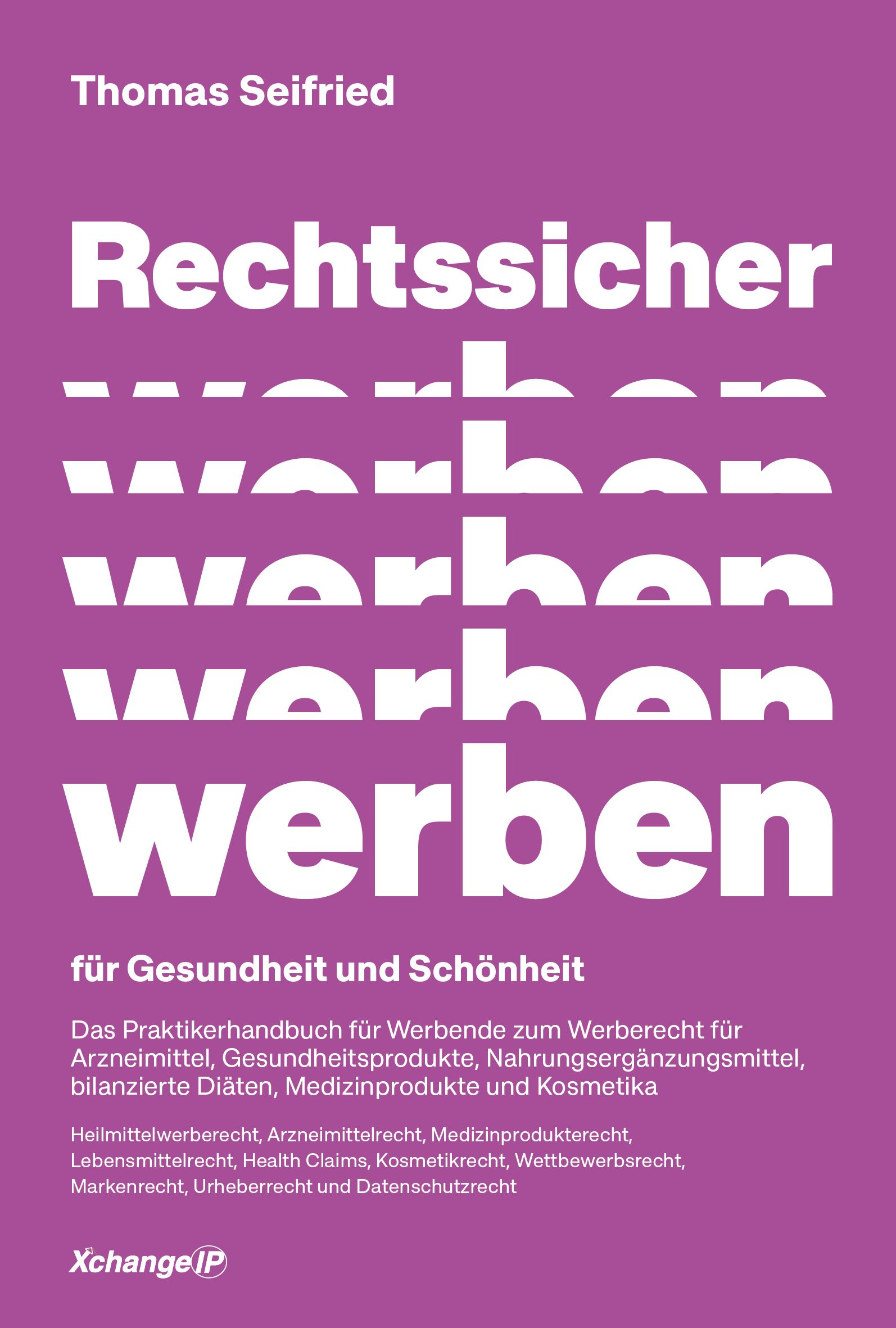
Advertising for health-related products is subject to particularly extensive regulation. Case law imposes strict requirements on health-related claims. Advertising for medicines and other remedies, medical devices, food supplements, foods for special medical purposes and cosmetics is also restricted by specific laws and regulations. The risk of cease-and-desist letters and legal disputes is particularly high for these products. This book sets out the current law through several hundred examples from case law.
Contents:
- Selection of terms, texts and media
- Advertising with Trademarks
- General principles of competition law, misleading and comparative advertising, advertising with prices and discounts
- Search engine optimisation and search engine advertising, social media and influencer marketing
- General requirements for health-related advertising
- Prohibitions and restrictions under medicines advertising law
- Advertising for medicinal products, pharmaceutical price controls, and advertising discounts and benefits
- Advertising medical devices
- Advertising food supplements, especially HEALTH CLAIMS
- Advertising for foods for special medical purposes
- Advertising for cosmetic products
Back to table of contents
1st edition, November 2024, 408 pages, XchangeIP Verlag, available from bookshops or Amazon
ISBN 978-3-00-079406-3
Who is subject to the German Medicines Advertising Act (HWG)?
Advertising for medicinal products and other health-related products and treatments, including for animals
Section 1 HWG defines the scope of the German Medicinal Products Advertising Act. The HWG therefore applies to advertising for
- medicinal products within the meaning of Section 2 of the German Medicinal Products Act (AMG),
- other products, methods, treatments and objects, where the advertising claim relates- to the diagnosis, elimination or alleviation of diseases, ailments, bodily injuries or pathological symptoms in humans,- to terminations of pregnancy, - to surgical plastic and cosmetic procedures to alter the human body without medical necessity.“Other products” also include cosmetic products within the meaning of Article 2(1)(a) of Regulation (EC) No 1223/2009 (EU Cosmetics Regulation). “Objects” also include personal care items within the meaning of § 2(6)(4) of the German Food and Feed Code.
- Procedures and treatments, insofar as the advertising claim relates to the diagnosis, elimination or alleviation of diseases, ailments, bodily injuries or pathological symptoms in animals.
Medical devices and in vitro diagnostic devices no longer fall within the scope of § 3 HWG. This is because misleading claims for these products are comprehensively regulated under European law, namely Article 7 MDR and Article 7 of the In Vitro Diagnostic Medical Devices Regulation.
What is “advertising” within the meaning of § 1 of the German Medicinal Products Advertising Act?
No definition of “advertising” in the German Medicinal Products Advertising Act
The German Medicines Advertising Act contains no statutory definition of “advertising”. Courts define advertising relevant under medicines advertising law as advertising designed to attract the attention of the target audience and arouse their interest, thereby
is intended to promote the sale of goods or services (BGH, judgment of 27 April 1995 – I ZR 116/93 – Oxygen multi-step therapy). This definition is similar to the general definition of advertising under competition law.
Definition of “advertising for medicinal products”
Under the law, certain advertising restrictions in the HWG apply only to medicinal products (Sections 3a, 4, 4a, 5, 10, 11(1) nos. 1 to 15, 11(2), 12(1) no. 1 HWG). According to case law (OLG Frankfurt a.M., judgment of 12.12.2019 – 6 U 189/18 – Melissenextrakt) and Article 86(1), first sentence, of EU Directive 2001/83/EC establishing a Community code relating to medicinal products for human use, which is binding on the interpretation of the HWG, advertising for medicinal products
“all measures to provide information, conduct market research and create incentives with the aim of promoting the prescription, supply, sale or consumption of medicinal products”.
Advertising for a medicinal product occurs when consumers equate the expressly advertised active ingredient with the medicine (BGH, judgment of 29.10.1992 - I ZR 89/91 – Bronchocedin), or when the plant from which the active ingredient is derived, rather than the active ingredient itself, is equated with the medicine (OLG Koblenz, judgment of 14.12.2016 - U 941/16 - Passionflower). “Advertising” within the meaning of the HWG can also include a statement on a package leaflet (see BGH v. 29.05.1991 - I ZR 284/89 - Katovit).
HWG applies only to product advertising
The German Medicinal Products Advertising Act does not apply to all advertising for medicinal products. Rather, it restricts advertising for products (product advertising or sales promotion), but not corporate advertising, such as advertising for a company or its image. The Act therefore applies only when medicinal products are being advertised, not when a company is being promoted in general.
Whether the advertising in question is product advertising or corporate advertising depends on whether the overall impression of the advertisement focuses on the company’s image or on promoting specific or at least identifiable products. Advertising the entire product range of a pharmacy is not corporate advertising, but product or sales promotion falling under Section 1(1) No. HWG (BGH, judgment of 18.11.2021 – I ZR 214/18 - Impermissible Advertising by an Online Pharmacy – Prize Draw Advertising II). This also applies where some of the products are not medicinal products (BGH of 26.3.2009 - I ZR 99/07 - DeguSmiles & more).
When the HWG applies to methods, treatments and objects
The HWG also applies to health-related advertising (see § 1 I No. 2, II HWG) for procedures, treatments and products. These may include medical therapies, for example.
Further examples: “Procedures and treatments” include, for example, visiting a salt cave (OLG Saarbrücken, 19.12.2018 - 1 U 41/18 - visit to a salt cave)
“Objects” include, for example, kinesiology tape (Federal Court of Justice, 20 February 2020 – I ZR 193/18 – Customer Reviews on Amazon).
Misleading claims of success under Section 3, sentence 2, no. 2(a) HWG
Misleading advertising under Section 3, sentence 2, no. 2(a) HWG occurs in particular when the false impression is created that the success of a medicinal product can be expected with certainty. It is not the promise of success itself that is prohibited, but creating the impression that success is certain. Whether such an impression is created depends on how the average advertising recipient understands the claim and does not require an explicit guarantee that success can always be expected (OLG Düsseldorf, 24 February 2022 – I-20 U 292/20 – Advertising by a naturopath using a patient’s medical history). It is sufficient to create the impression that success can usually be guaranteed.
Example
The claim
“rapid and reliable reduction in the severity of typical cold symptoms”
for a homeopathic medicinal product constitutes an impermissible guarantee of success (LG Dortmund, 23 September 2022 – 25 O 22/22).
Misrepresentation concerning the personal qualities or characteristics of the manufacturer or inventor under § 3 sentence 2, No. 3(b) HWG
False statements about the manufacturer’s, inventor’s or their employees’ identity, education, qualifications or achievements are also misleading. In practice, misleading professional titles and institutional designations are particularly relevant.
Restrictions on advertising medicinal products, procedures, treatments, objects and products outside professional circles (to consumers) under Section 11 HWG
Restrictions on advertising medicinal products to consumers
Section 11 HWG sets out a list of advertising prohibitions directed at consumers for medicinal products, procedures, treatments, objects and products.
Applies only to a limited extent to medical devices
Under § 11(1), sentence 2 HWG, most of these advertising prohibitions do not apply to medical devices; only the prohibitions under § 11(1) nos. 7 to 9, 11 and 12 HWG apply.
Prohibition on advertising with professional recommendations under § 11 Abs. 1 Nr. 2 HWG
Under Section 11(1) No. 2 HWG, medicinal products may not be advertised to consumers using statements or images that refer to a recommendation by scientists, healthcare or animal-health professionals, or other people. A professional recommendation does not have to come from a specific individual. Advertising that suggests a recommendation by a group of people or an industry is also prohibited. Nor does it have to use the word “recommendation” or “recommends.”
ExamplesThe advertising claim “Modern medicine is therefore increasingly turning to the herbal medicinal product XY®…” constitutes an unlawful recommendation by a healthcare professional (Federal Court of Justice, judgment of 18 Jan 2012 − I ZR 83/11 - Euminz).Likewise, the advertisement "BEST COLD REMEDY OF 2014 - VOTED FOR BY [a professional association of pharmacists]" constitutes an unlawful recommendation by a healthcare professional (Frankfurt am Main Higher Regional Court, judgment of 12 Feb 2015 - 6 U 184/14 - Advertising to the general public), as does advertising for hearing aids with the claim "Recommended by an ENT specialist" (Hamm Higher Regional Court, judgment of 13 Jun 2019 - I-4 U 5/19 - Advertising a hearing aid with a specialist recommendation).
“Scientists” refers to experts in the field. This may also include a “study group at the University of Würzburg” (OLG Koblenz, judgment of 14.12.2016 – 9 U 941/16 - Passionflower).
Advertising by reproducing patient histories under § 11(1), first sentence, no. 3 HWG
Advertisements featuring accounts of illness are generally permissible. Under § 11(1), sentence 1, no. 3 HWG, such advertising is prohibited only if it is abusive, offensive or misleading, or if a detailed description or depiction could lead to an incorrect self-diagnosis. The provision is therefore of limited practical significance.
Advertising using repulsive imagery under Section 11(1), sentence 1, no. 5 of the German Medicines Advertising Act (HWG)
Under Section 11(1), sentence 1, No. 5 HWG, depictions of changes to the human body caused by disease or injury, or of the effects of a medicinal product, are prohibited if they are abusive, repulsive or misleading. A discreet depiction of cold sores is not necessarily repulsive (OLG Hamburg, judgment of 10.4.2008 - 3 U 182/07 - Depiction of Cold Sores in a TV Commercial).
Ban on surreptitious advertising using repulsive images under § 11(1) sentence 1 no. 9 of the German Medicinal Products Advertising Act
Publications whose advertising purpose is misleading or not clearly identifiable (advertorials) are also unlawful, Section 11(1), sentence 1, no. 9 of the German Therapeutic Products Advertising Act (HWG). The main examples are advertisements presented as editorial content and influencer marketing.
Advertising using third-party statements under Section 11(1), sentence 1, no. 11 of the German Medicines Advertising Act (HWG)
Section 11(1), sentence 1, no. 11 HWG prohibits advertising using statements by third parties. “Third parties” are people associated with the advertiser whose opinions are therefore considered credible. The law expressly includes letters of thanks, appreciation and recommendation. The ban also covers customer reviews.
Further advertising prohibitions applicable to the general public
The following are also prohibited under § 11 Abs. 1 S. 1 HWG
- Under Section 11(1), first sentence, No. 7 HWG, advertising claims suggesting that health could be impaired by not using a medicinal product, or improved by using it, are prohibited. This provision is considered poorly drafted and has little practical significance. Since all advertising for a medicinal product ultimately promises an improvement in health, it is unclear what the provision is intended to regulate;
- under § 11 Abs. 1 S. 1 Nr. 8 HWG, promotional presentations at which the speaker’s addresses are handed out or addresses are collected from the audience. This provision targets coffee trips where arthritis blankets or similar products are sold and is of little practical significance;
- under Section 11(1), first sentence, No. 12 of the German Medicinal Products Advertising Act, advertising measures directed exclusively or predominantly at children under 14;
- under § 11(1), sentence 1, no. 13 HWG prize competitions and games of chance whose outcome depends on chance, where such measures or procedures encourage the inappropriate or excessive use of medicinal products. However, even the opportunity to enter a prize draw in which participants can win a prize by submitting a prescription constitutes an impermissible promotional gift under § 7 HWG (see BGH, judgment of 18 November 2021 – I ZR 214/18 - Gewinnspielwerbung II). The provision therefore has limited practical application;
- under Section 11(1), first sentence, No. 14 HWG, the supply of medicinal products, their samples or specimens, or vouchers for them,
- the provision, contrary to Section 11(1), sentence 1, no. 15 HWG, of free samples or trial products of other products or items, or vouchers for them.
Ban on advertising surgical cosmetic procedures using before-and-after images under Section 11(1), sentence 3 of the German Medicines Advertising Act (HWG)
Advertising is prohibited for the surgical plastic procedures referred to in Section 1(1)(2)(c) HWG if it compares the body or appearance before and after the procedure to show the effects of the treatment. “Plastic surgery” means surgery that is not medically necessary, for example
- a hair transplant (LG Berlin, order of 12 July 2018 – 52 O 135/18 – Hair Clinic) or
- buttock enlargement, “Brazilian Butt Lift” (OLG Düsseldorf, judgment of 17 February 2022 – 15 U 24/21 – Brazilian Butt Lift).
It does not matter whether the medical indication for the advertised procedure actually existed. Advertising for plastic surgery is prohibited if the target audience could not tell that the surgical procedure was not medically necessary. Before-and-after images suggest that a procedure was not medically necessary if it is not apparent that the patient’s underlying symptoms improved (OLG Düsseldorf, judgment of 27.04.2023 – 20 U 66/22 - consumer understanding of advertising for liposuction of the abdomen and breasts).
Advertising for cosmetic plastic surgery procedures that is aimed exclusively or primarily at children and young people is also prohibited.
Prohibition on benefits and other promotional gifts under Section 7 HWG – Cash and bulk discounts
Discounts
Under Section 7 HWG, advertising medicinal products with benefits or promotional gifts is subject to restrictions. Under Section 7(1), No. 1 HWG, benefits and promotional gifts for medicinal products are prohibited if they breach provisions made under the Medicinal Products Act (Section 78 AMG in conjunction with the AMPriceV).
> Read here about the effects of the ban on benefits under the German Health Products Advertising Act on medicinal product prices
This restriction applies to cash discounts and in-kind discounts (quantity discounts). A “promotional gift” is any benefit with a monetary value that, from the recipient’s perspective, is provided free of charge (BGH, order of 20 February 2020 – I ZR 214/18 – Prize Promotion I). Cash discounts are permitted if they consist of a specified monetary amount (§ 7(1), No. 2(a) HWG). Credits towards future purchases are not cash discounts (BGH, judgment of 17 July 2025 – I ZR 43/24 – PAYBACK credits).
Quantity discounts are permitted if the benefit is an identical product (Section 7(1) No. 2(b) HWG).
Exceptions to the prohibition on benefits
Low-value items worth up to €1.00
Not all benefits or promotional gifts are prohibited. Low-value items are permitted, but must be clearly and permanently labelled with the name of the advertiser, the advertised product or both. Without an advertising imprint, only low-value trinkets are permitted. Under § 7 No. 5 HWG, customer magazines (e.g. „Apotheken Umschau“) are also permitted.
The term “low-value token gift” applies only to items of such low value that any material undue influence on the advertising audience can be ruled out. The value limit is €1 (BGH, judgment of 17 July 2025 – I ZR 43/24 – PAYBACK credits).
For medicine prices, Section 78(2) of the German Medicinal Products Act (AMG), in conjunction with Sections 1(1) and (4) and 3 of the Pharmaceutical Price Regulation, must be observed, particularly the price controls for prescription medicines. Whether discounts and rebates constitute prohibited promotional gifts must also be assessed against the pharmaceutical pricing rules under Section 7 of the German Medicines Advertising Act. If no pharmaceutical pricing rules have been violated, discounts and rebates are not prohibited under Section 7(1), first sentence, of the HWG because the exception in Section 7(1)(2)(a) of the HWG applies (Federal Court of Justice, judgment of 5 October 2017 – I ZR 172/16 – Wholesale mark-ups).
Customary commercial accessories
Under Section 7(1), No. 1, first half-sentence, HWG, medicinal products may also be advertised by offering a customary accessory.
Example (Higher Regional Court of Cologne, 7 December 2018 – 6 U 95/18 – vaccine service items) If a pharmacist advertises vaccines to doctors and offers free “service items” (application aids – needles size 18 (1 pack / 100 pcs.), needles size 16 (1 pack / 100 pcs.), injection plasters (1 pack / 100 pcs.), alcohol swabs (in a handy box), needle disposal container (1.5 L)) worth 0.8% of the value of the goods, these are permissible accessories.
Customary ancillary benefits
Customary commercial incidental benefits are also permissible. Incidental benefits are customary in the trade if they can be separated from the main service and, according to general opinion, are consistent with reasonable commercial practices (OLG Köln v. 20.5.2016 – 6 U 155/15 – Free Lasik Quick Check). Classic examples of permissible customary commercial incidental benefits include reimbursement of travel costs to a business by public transport, but not by a private hire service (e.g. taxi).
Examples of violations of the prohibition on giving benefits under Section 7 HWG
- The chance to enter a prize draw is an impermissible promotional gift within the meaning of Section 7 HWG (BGH, judgment of 18.11.2021 – I ZR 214/18 - Prize Draw Advertising II)
- Providing a voucher for bread rolls with the purchase of a prescription medicine at a pharmacy is an impermissible promotional gift (BGH, judgment of 6 June 2019 - I ZR 206/17 - Brötchen-Gutschein).
- A pharmacy’s free issue of a one-euro voucher with a medicinal product purchase, redeemable against the next purchase of a price-controlled prescription medicine, is an unlawful promotional gift (Federal Court of Justice, judgment of 6 June 2019 – I ZR 60/18 – One-Euro Voucher).
Further examples of violations of the German Medicines Advertising Act
Examples from case law
- The following advertising claims for a medical device (healing clay) are misleading: “Supports the body’s detoxification”, “As a mineral catalyst, removes free radicals from food”, “For food intolerance caused by histamine intolerance”, “natural detoxification”, “Numerous studies show that pollutants and environmental toxins can harm the body and even impair cell function. Fatigue, reduced physical and mental performance, or a weakened immune system can result. Regular detoxification can promote the wellbeing, defences and vitality of the whole body”, “Internal cleansing for a healthy body”, “Supports detoxification and the elimination of waste products”, “Relieves the burden on the liver and kidneys”, “Against harmful substances, heavy metals, plasticisers, and bacterial and mould toxins in food”, “Active protection against free radicals”, “X® healing clay can naturally and effectively break down free radicals from food as a mineral catalyst and protect against the resulting damage caused by oxidative stress”, “X® healing clay can bind histamines and other biogenic amines in food. Symptoms can be alleviated and quality of life naturally improved” (Frankfurt am Main Higher Regional Court, judgment of 2 Dec 2021 – 6 U 121/20 - Healing Clay for Detoxification)
- Before-and-after images often violate Section 11(1) of the German Advertising of Medicinal Products Act (HWG) (e.g. OLG Düsseldorf, judgment of 27 April 2023 – I-20 U 66/22).
Examples of HWG violations involving food supplements (NEM)
Examples from case law
- Food supplements must not be presented in a way that falsely suggests they are medicinal products. The warning “For risks and side effects, read the package leaflet and ask your doctor or pharmacist” is therefore misleading, as it creates the false impression that these products are medicinal products (Higher Regional Court of Dresden, judgment of 15 January 2019 – 14 U 941/18).
- Despite the clearly legible information on the packaging that the product consists of “food supplement tablets”, a product may be classified as a medicinal product by presentation if its prominently displayed product name, typography and colours remind consumers of familiar medicinal products, and if it is sold exclusively in pharmacies (Higher Regional Court of Cologne, judgment of 12 October 2007 – 6 U 56/07 Donaprevent)
- A product for building muscle mass is not necessarily a medicinal product. A product’s muscle-building effect does not always and necessarily indicate a medicinal purpose. Such a product may instead meet particular physiological needs, and the resulting nutritional requirements, of a specific group of people—such as high-performance, strength or endurance athletes—and thus constitute a dietary food within the meaning of § 1(2)(1)(b) DiätVO (BGH, judgment of 6 May 2004 – I ZR 275/01 – Sportlernahrung II).
Violations of the Health Claims Regulation (HCVO) in food supplement advertising
Advertising food supplements may also breach food law. Foods are subject to the “Health Claims Regulation” - HCVO (Regulation [EC] No. 1924/2006 of the European Parliament and of the Council of 20.12.2006 on nutrition and health claims made on foods). The HCVO regulates health claims made for foods. It is intended to provide consumers with clear information. Nutrition claims are permitted only if they are listed in the Annex to the HCVO and comply with the Regulation. The details matter.
Find detailed information on the Health Claims Regulation here.
Violations of the Food Information Regulation (LMIV)
Advertising for food supplements is also often challenged for violations of food law.
Here you can find information about violations of the LMIV in food advertising.
Author: Thomas Seifried, Lawyer specialising in medicinal products advertising law and Specialist lawyer for intellectual property law
Cease-and-desist letters in medicines advertising law
Competitors and trade associations can take action against violations of healthcare advertising law
Cease-and-desist notices from competitors, qualified trade associations and qualified entities
The prohibition on misleading advertising under Section 3 HWG is a rule governing market conduct (BGH, judgment of 5.11.2020 – I ZR 204/19 – Sinupret). The same applies to the ban on advertising outside professional circles under Section 12 HWG (OLG Hamm, judgment of 9.2.2023 – 4 U 144/22 – Unlautere Heilmittelwerbung), Section 11(1), sentence 1, no. 2 HWG, which prohibits medicinal product advertising containing professional endorsements (BGH, judgment of 18.1.2012 − I ZR 83/11 – Euminz), and the ban on advertising surgical cosmetic procedures under Section 11(1), sentence 3 (OLG Düsseldorf, judgment of 27.04.2023 – 20 U 66/22 – Verkehrsverständnis bei Werbung für chirurgischen Eingriff der Fettabsaugung an Bauch und Brust). These prohibitions may therefore be enforced through competition-law cease-and-desist letters and interim injunctions by competitors, qualified trade associations (such as Verband Sozialer Wettbewerb e.V. or Wettbewerbszentrale) and qualified entities.
Commonly challenged violations
- Typical violations of the German Act on the Advertising of Medicinal Products (HWG) include, for example, misleading advertising of non-prescription medicines.
- Violations of the prohibition on benefits (Section 7(1) HWG) are also frequently challenged, for example, product advertising that offers benefits of more than nominal value (e.g. vouchers, rewards) or free consultations.
- Complaints are also often made about advertising to the general public that is prohibited under §§ 11 ff. HWG, for example, advertising featuring testimonials’ recommendations to consumers.
- Advertising based on scientific studies is regularly challenged on the grounds that the studies do not comply with accepted standards of scientific research. This is the case where there is no randomised, placebo-controlled, double-blind study with adequate statistical analysis that has been made part of the scientific community’s debate through publication.
Cease-and-desist notices from the Social Competition Association (Verband sozialer Wettbewerb e. V.), Berlin
The association’s members include chambers of pharmacists and doctors, the Association of German Mail-Order Pharmacies, mail-order retailers of all kinds, medical supply stores selling health food and drugstore products, naturopaths, manufacturers of medicinal products and cosmetics, operators of health clinics, suppliers of natural remedies and pharmaceutical products, and companies in the food sector. The Association for Social Competition e. V. primarily challenges violations involving food, medicinal products, cosmetics, health and wellness. The association sets short deadlines for submitting a cease-and-desist undertaking backed by a contractual penalty. Nevertheless, you should not sign such undertakings hastily. A lawyer specialising in medicinal product advertising law can help. The Association for Social Competition consistently pursues breaches of any undertaking once it has been given.