


Cease-and-desist letters over health claims (“health-related advertising”): Legal requirements and examples, with a free initial assessment of your case
Strict rules for health advertising - What does “health-related advertising” mean?
Distinguishing “health-related advertising” from “health claims” under the Health Claims Regulation (HCVO)
Health advertising—that is, advertising products with properties that affect health—is subject to the particularly strict rules governing “health-related advertising”. “Health-related advertising” should not be confused with “health claims” under the Health Claims Regulation (HCVO) for food. The principles governing health-related advertising were established by case law on competition law and apply not only to food, but to all product groups. “Health claims”, in turn, are a specific form of health-related advertising that applies exclusively to food and food supplements and is governed by the Health Claims Regulation (HCVO). The legal basis is Regulation (EC) No 1924/2006 of the European Parliament and of the Council, which entered into force on 1 July 2007. Under Article 2(2)(5) of the HCVO, a health claim is defined as “any claim that states, suggests or implies that a relationship exists between a food category, a food or one of its constituents and health”. These health claims within the meaning of the HCVO have nothing to do with the competition-law requirements for health-related advertising developed by case law.
For more information, see our article on the Health Claims Regulation.
Legal framework for health advertising
Act Against Unfair Competition (UWG)
The legal assessment of health-related advertising is governed by the German Act Against Unfair Competition (UWG), in particular the prohibition on unfair commercial practices under Sections 3 and 5 UWG in the form of misleading advertising. The courts have established strict rules in this area: advertising is considered “health-related” as soon as it refers to health (BGH, 3 May 2001 – I ZR 318/98 – Das Beste jeden Morgen). This is also the case where the aim is aesthetic rather than health-related, if the treatment involves an intervention in the body’s physical integrity—for example, fat removal through cryolipolysis (OLG München, 5 July 2018 – 29 U 1866/17 – Bye-bye-Hüftgold).
Definition in case law
Case law takes a broad view of what constitutes health-related advertising: the decisive factor is the impression the advertising claim makes on the average, reasonably well-informed, observant and circumspect consumer (Higher Regional Court of Stuttgart, judgment of 4 November 2021 – 2 U 49/21). If it is understood as a specific claim relating to health—not as exaggeration or an empty phrase amounting to a general “wellness” promise—it is classified as a health claim (Higher Regional Court of Munich, judgment of 4 May 2023 – 29 U 458/22). The key question is whether the claim suggests a causal link between consuming or using a product and the user’s health. Explicit references to health are not the only relevant factor; even implicit references can qualify advertising as health-related.
Which products are subject to the rules for health-related advertising?
The principles governing health-related advertising apply to all product categories—including mattresses, pet food and hair care products.
The principles governing health-related advertising apply not only to the particularly regulated advertising of food, advertising food with nutrition or health claims under the HCVO, advertising food supplements and advertising medicinal products, but to any product advertised in connection with health. This can also include a room spray (see OLG München, v. 04.05.2023 – 29 U 458/22).
Example: Health-related advertising for a “grounding bed sheet”
The principles established by case law on health-related advertising also apply, for example, to a “grounding bedsheet”. An advertisement for a grounding bedsheet using the words
“Original grounding bed products for better, restful sleep, more daytime energy and well-being” is misleading and constitutes unlawful health-related advertising if the claim is not scientifically substantiated (OLG Karlsruhe, judgment of 25 January 2023 – 6 U 373/22 – grounding bed sheet).
Examples: Misleading health claims in mattress advertising
Mattresses, too, may not be advertised with claims such as “falling asleep more easily”, “better sleep quality”, “faster recovery”, “improved well-being” or “more energy and performance” without evidence of established scientific findings (see below) (LG Hamburg, order of 8 November 2024 - 312 O 396/24). This also applies to such claims in user comments and customer reviews.
Advertising a mattress as "orthopedic" may lead a significant proportion of consumers to believe—incorrectly—that it is generally suitable, without individual adjustment, for producing health benefits, that is, for preventing or alleviating disorders of the human musculoskeletal system (OLG Cologne, judgment of 5.9.2025 - 6 W 53/25 - Orthopedic Mattress).
Example: Health claims in pet food advertising
The principles governing health claims also apply to feed and pet food (Higher Regional Court of Koblenz, judgment of 10 May 2021 – 9 U 1586/20 – Health claims for animal supplements; Higher Regional Court of Koblenz, judgment of 10 May 2021 – 9 U 1586/20, GRUR-RS 2021, 20110; Higher Regional Court of Koblenz, judgment of 16 January 2019 – 9 U 1062/18; Higher Regional Court of Stuttgart, GRUR-RR 2020, 12). Advertising dog biscuits with the words
“… What ‘ailments’, complaints and illnesses can …[B] help your dog with? […] The most common physical and emotional conditions include: […] anxiety, epilepsy, infections, […], restlessness, sleep disorders. These are just a few examples of conditions for which …[B] may be useful in dogs. Researchers believe that …[B] could also produce positive results in many other areas. […] there are already numerous testimonials from dog owners. For example, dogs were able to travel more calmly by car after using …[B]-oil […] For many dogs, targeted use in the evening also led to longer, deeper sleep when they had trouble sleeping.”
constitutes misleading, unlawful health-related advertising if these claims are not scientifically substantiated (example: OLG Koblenz, judgment of 10 May 2021 – 9 U 1586/20 – health claims for animal feed supplements).
Strict legal requirements for health-related advertising
Evidence of established scientific findings through studies
Health advertising that claims a product promotes health or alleviates illness must meet the so-called “strict standard” principle. This principle means that, in general and regardless of whether the German Act on the Advertising of Medicinal Products (HWG) or the HCVO applies, health-related advertising is misleading if the claimed effect is not supported by established scientific evidence, or if it promotes a disputed professional opinion without mentioning the opposing view (BGH, judgment of 6 February 2013 – I ZR 62/11 – Basisinsulin mit Gewichtsvorteil). Study results cited in advertising or proceedings to substantiate a health-related claim are sufficiently probative only if the studies were conducted and evaluated in accordance with recognised scientific research standards and principles.
Requirements for studies: the scientific gold standard
For health-related advertising to be lawful, it must meet the so-called “scientific gold standard”. This requires a randomised, placebo-controlled, double-blind study with an appropriate statistical analysis, published and thereby opened to scrutiny by the scientific community (see BGH, judgment of 2.10.2008 – I ZR 51/06 – Priorin). The study must relate to the product being advertised and support the advertising claim. Any doubts about efficacy raised in the study must also be disclosed in the advertising (OLG Karlsruhe, judgment of 25.01.2023 – 6 U 373/22 – Ableitung von Elektrosmog durch Erdungsbetttuch).
A scientific study must be neutral. Sponsorship by the manufacturer itself does not compromise its neutrality, since it would be unreasonable to expect a company to wait for an independent party to take a scientific interest. However, doubts about neutrality may arise if the study design is discussed in detail with the manufacturer (see Higher Regional Court of Berlin, judgment of 27 November 2015 – 5 U 20/14 – misleading advertising about the lasting effect of cellulite treatments).
Health-related award logos (“FOCUS Top Mediziner”)
These strict requirements also apply to test seals, e.g. the seals “FOCUS Top Mediziner” and “FOCUS Empfehlung”. Health-related test logos are subject to strict requirements regarding both the test procedure used and the design of the logos, in particular as to accuracy and credibility. If the test procedure limits the significance of the results, the logos must not make unqualified claims but must make those limitations clear (Federal Court of Justice, judgment of 30 July 2026 - I ZR 130/25 - Strict requirements for the accuracy of doctors’ test seals).
Evidence of established scientific findings for animal feed
Some courts apply a lower standard of scientific substantiation to advertising claims for animal feed, finding them permissible even when they are controversial in scientific circles or the subject of scientific debate. For animal feed, a claim about effects may be sufficiently scientifically substantiated if it reflects the prevailing scientific opinion, even if opposing views exist without significant scientific weight (Stuttgart Higher Regional Court, judgment of 6 Jun 2019 – 2 U 144/18 - Health Claims for Animal Feed - Anti-Tick Snack; Schleswig Higher Regional Court, judgment of 20 Mar 2014 – 6 U 3/12).
When scientific studies must be available for health-related advertising
The scientific substantiation of the efficacy claim must be documented at the time the advertisement is published (Higher Regional Court of Hamburg, 23 June 2022 – 5 U 173/19, para. 166 – Whole-body cryotherapy; Higher Regional Court of Frankfurt am Main, 2 December 2021 – 6 U 121/20, para. 46 – Healing clay for detoxification; Higher Regional Court of Saarbrücken, 19 December 2018 – 1 U 41/18 – Salzgrotte Maritim Air; Higher Regional Court of Hamm, 20 May 2014 – 4 U 57/13, para. 78; Higher Regional Court of Munich, 14 May 2009 – 6 U 2187/06, para. 94; Higher Regional Court of Düsseldorf, 13 November 2007 – 20 U 172/06, para. 21). Obtaining an expert report only once court proceedings are under way is not sufficient. Waiving this requirement would give advertisers a free pass to “play roulette” with the health of potential patients (Higher Regional Court of Saarbrücken, 19 December 2018 – 1 U 41/18 – Salzgrotte Maritim Air).
Everything you need to know about health-related advertising – in the practical guide
Buy now and avoid costly cease-and-desist notices for unlawful health-related advertising
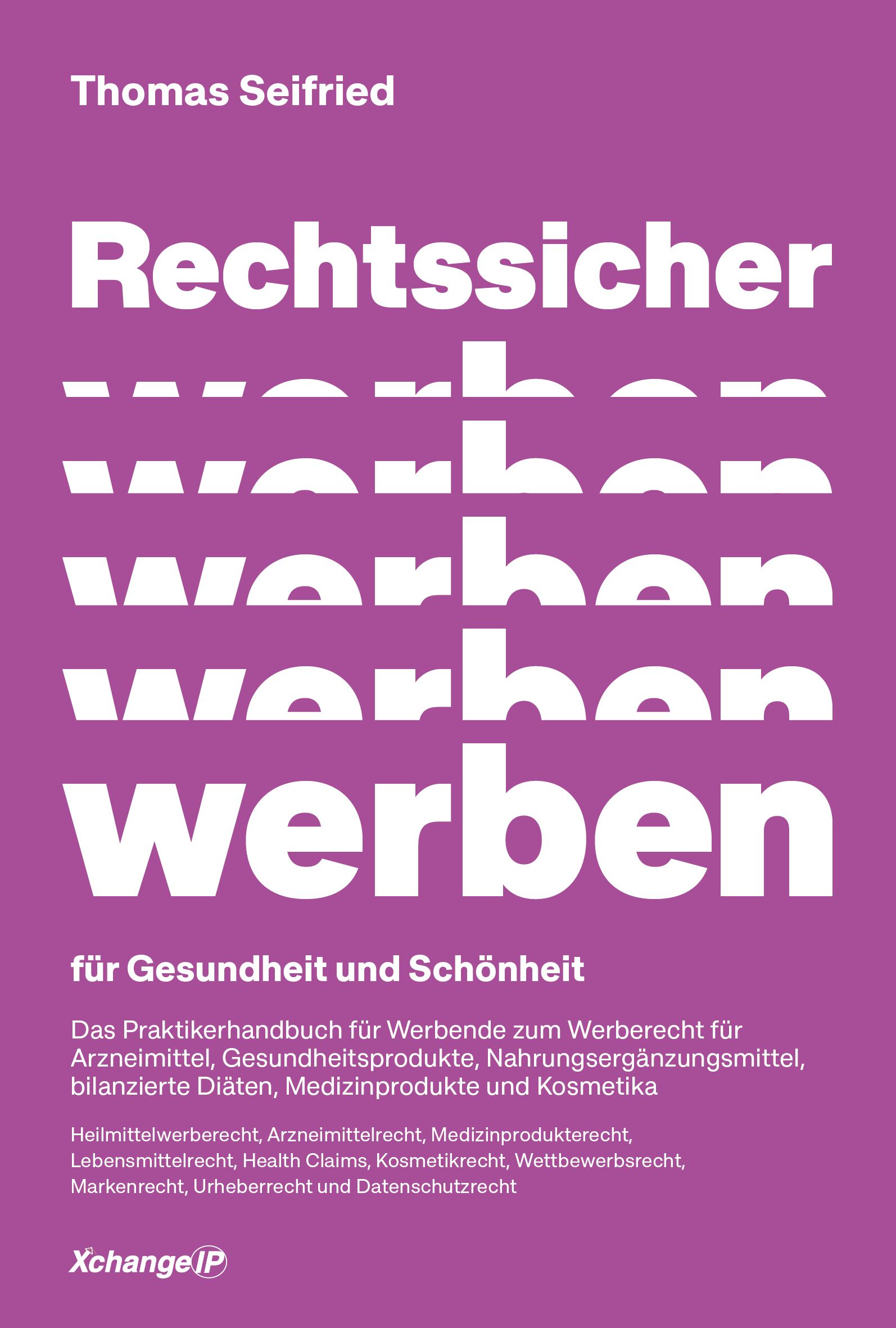
Advertising for health-related products is subject to particularly strict legal regulation. Courts set high standards for health-related claims. Advertising for medicines and other remedies, medical devices, food supplements, foods for special medical purposes and cosmetics is also restricted by specific laws and regulations. The risk of cease-and-desist notices and legal disputes is particularly high for these products. This book sets out the current legal position using several hundred examples from case law.
Back to table of contents
1st edition, November 2024, 408 pages, XchangeIP Verlag, available from bookshops or Amazon
ISBN 978-3-00-079406-3
Cease-and-desist letters and preliminary injunctions relating to health claims in advertising
Unlawful health-related advertising is often challenged by a cease-and-desist letter under competition law (see below) or through preliminary injunction proceedings.
Examples of unlawful health claims in case law
Grounding bed sheet (OLG Karlsruhe)
Advertising for a grounding bed sheet with the claim
“for better, restful sleep, more energy during the day and a sense of well-being”
is an impermissible health claim if the advertising promise is not supported by scientifically substantiated findings (OLG Karlsruhe, 25.2.2023 – 6 U 373/22 – grounding bed sheet).
Caffeine for hair loss (Federal Court of Justice)
A health claim in advertising for a hair care product is misleading if it uses the words
“Caffeine to combat hair loss”
if the suggested effect of the product has not been scientifically proven (BGH, 21 January 2010 – I ZR 27/07 – Caffeine Against Hair Loss, applying the former Section 27(1) LFGB).
Oil pulling (Higher Regional Court of Koblenz)
Advertising a mouth-pulling oil (mint oil) with the claim is misleading
“with regular use, the treatment cares for the teeth and gums and has an anti-inflammatory effect”,
if the advertiser cannot provide evidence of a scientifically established effect (OLG Koblenz, 20 July 2022 – 9 U 490/22 – Oil pulling).
Salt cave (OLG Saarbrücken)
Advertising for a visit to a salt cave using the words
“A visit to the salt cave has positive effects on SKIN CONDITIONS SUCH AS ATOPIC DERMATITIS”
is misleading if the claim is not supported by established scientific findings (OLG Saarbrücken, judgment of 19 December 2018 – 1 U 41/18 – Unzulässige gesundheitsbezogene Werbung für den Besuch einer Salzgrotte).
Thomas Seifried, Lawyer for Healthcare Advertising -
Free initial assessment of your specific case
Competition Law Attorney Thomas Seifried has over 20 years’ experience in competition and advertising law and has been a Certified Specialist in Intellectual Property Law since 2007. His clients include businesses ranging from start-ups to listed companies. Thomas Seifried advises and represents pharmacists and companies distributing healthcare products, food supplements, cosmetics and medical devices. Thomas Seifried is the author of the practitioner’s guide to advertising law for medicinal products, medical devices, food supplements and cosmetics, “Advertising for Health and Beauty with Legal Confidence”, and is a contact for leading media outlets on advertising law. As an attorney specialising in advertising law for medicinal products, he advises and represents companies throughout Germany, both out of court and in court, particularly in interim injunction proceedings, with notable successes before regional and higher regional courts.
Cease-and-desist letter over health-related advertising
Cease-and-desist letters from competitors and associations
Misleading health-related advertising is often challenged by competitors. In addition, qualified trade associations (e.g. the Association for Social Competition or the Centre for Protection against Unfair Competition) also issue cease-and-desist notices. Members of the Association for Social Competition include, among others, pharmacists’ chambers, medical associations, the Association of German Mail-Order Pharmacies, retailers of all kinds, medical supply stores selling health food and drugstore products, naturopaths, manufacturers of medicinal products and cosmetics, operators of health resorts, providers of natural remedies and pharmaceutical products, and companies in the food industry. The Association for Social Competition primarily challenges violations involving food, remedies, cosmetics, health and wellness. The association sets short deadlines for submitting cease-and-desist declarations backed by a contractual penalty. Nevertheless, cease-and-desist declarations should not be signed hastily. A lawyer specialising in medicinal product advertising law can help. The Association for Social Competition consistently enforces breaches of cease-and-desist declarations once they have been submitted.
Finally, unlawful health-related advertising is also pursued by qualified entities through cease-and-desist letters under competition law and preliminary injunctions.
Typical grounds for cease-and-desist letters
Frequently subject to warning letters
- Health-related advertising where the advertising claim is not supported by established scientific evidence.
- Advertising that cites scientific studies is challenged because the studies do not meet accepted standards of scientific research. Missing source references are also frequently objected to.
What should businesses do after receiving a cease-and-desist notice over health-related advertising?
After receiving a cease-and-desist letter over allegedly unlawful health-related advertising, the following steps are recommended:
1. Note the deadlines in the cease-and-desist letter. Do not wait until the deadline expires; act immediately.
A short deadline of just one week is often set for submitting a cease-and-desist undertaking backed by a contractual penalty. Failure to respond in time may result in court proceedings for an interim injunction. Don’t wait until the deadline expires—seek advice from a competition law lawyer immediately.
2. Documenting health-related advertising
Keep copies of all challenged advertising materials, webpages, social media posts and product images. Provide information about the environmental claim in question and any sustainability labels used, in particular the certification requirements.
3. Don’t sign a cease-and-desist undertaking prematurely
The attached cease-and-desist undertaking backed by a contractual penalty serves the interests of the sender. It is often too broadly worded. This alone may make it an abusive cease-and-desist letter. Whether it should be signed in this form requires careful legal review.
4. Have the prospects of legal success assessed
Not every cease-and-desist letter alleging unlawful health-related advertising is justified. In particular, the following should be examined
- the standing of the party issuing the cease-and-desist notice,
- standing to be sued
- whether the alleged unfair competition violation has occurred,
- the scope of the claims for injunctive relief and
- the amount of the claimed costs of the cease-and-desist notice.
When it makes sense to consult a lawyer specialising in health claims in advertising
If you receive a cease-and-desist notice concerning health-related advertising, you should seek legal advice. Advertising for food supplements is particularly vulnerable to such notices. Even minor violations can lead to substantial costs from cease-and-desist notices, court proceedings and potential product recalls. If you receive a cease-and-desist notice or face court proceedings concerning unlawful health-related advertising, you should consult a lawyer with relevant specialist expertise and experience.
Author: Thomas Seifried, lawyer specialising in health-related advertising and specialist lawyer for intellectual property law