


Advertising cosmetic products (cosmetics) - Legal guide and free initial assessment of your case
EU Cosmetics Regulation and EU Cosmetics Claims Regulation
Advertising for cosmetic products (“cosmetics”) is governed by the EU Cosmetics Regulation – Regulation (EC) No 1223/2009 – supplemented by the EU Cosmetics Claims Regulation (Commission Regulation (EU) No 655/2013 of 10 July 2013 laying down common criteria for the justification of claims used in relation to cosmetic products). Exception: The cosmetic product is classified as a medicinal product because of its advertising or pharmacological effect (see below).
Unlawful advertising for cosmetics is misleading advertising under competition law and is often challenged by means of a cease-and-desist letter under competition law or an application for an interim injunction.
Health-related advertising claims in cosmetics
Cosmetic products that make health-related claims are also subject to the stricter general principles of competition law governing health-related advertising. Particular attention must be paid to substantiating advertising claims with scientific evidence.
Example: The name is not misleading
„Clinique“
for cosmetic products. Since these products are sold not in pharmacies, but only in perfumeries and cosmetics departments of department stores, consumers cannot be misled into believing they have a medicinal effect (CJEU, 2 February 1994 – C-315/92 – “Clinique”).
The practical handbook on the law governing advertising for medicinal products, food supplements, health claims, foods for special medical purposes, medical devices and cosmetics
Buy now and avoid costly warning letters
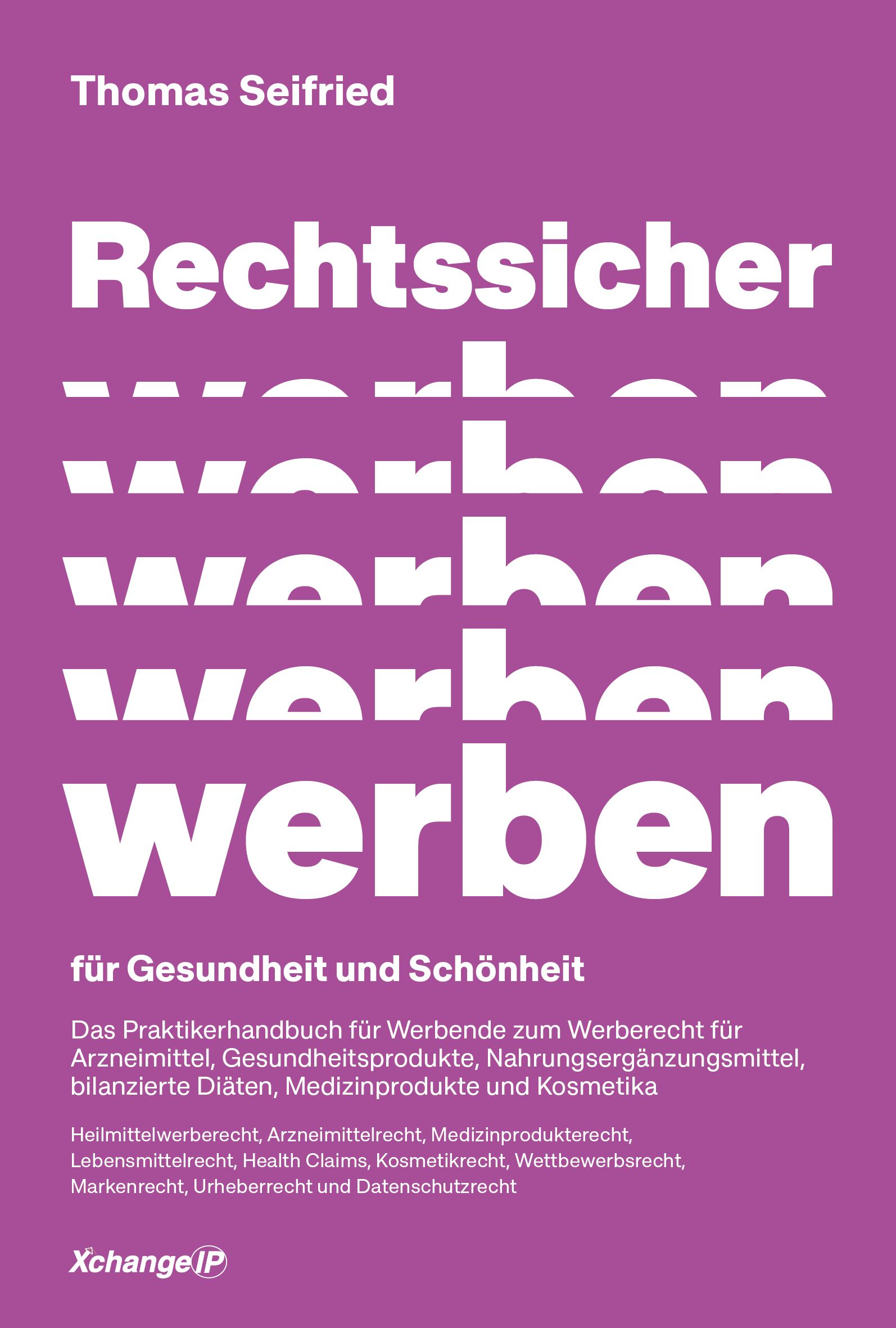
Advertising for health-related products is subject to particularly strict legal regulation. Courts set high standards for health-related claims. Advertising for medicines and other remedies, medical devices, food supplements, foods for special medical purposes and cosmetics is also restricted by specific laws and regulations. The risk of cease-and-desist notices and legal disputes is particularly high for these products. The specialist book “Advertising for Health and Beauty with Legal Certainty” sets out the current legal position using several hundred examples from case law.
Back to table of contents
1st edition, November 2024, 408 pages, XchangeIP Verlag, available from bookshops or Amazon
ISBN 978-3-00-079406-3
Cosmetics advertising with claims of pharmacological effects
If advertising for a cosmetic product also suggests a pharmacological effect, the principles governing medicinal product advertising apply.
Definition of “cosmetic products” under the EU Cosmetics Regulation
External use
Whether the EU Cosmetics Regulation and the EU Cosmetics Claims Regulation apply to cosmetic products depends on whether the product is a “cosmetic product” within the meaning of the Cosmetics Regulation. Cosmetic products in this sense are only substances or mixtures intended to come into “external” contact with the body (skin, hair system, nails, lips and external intimate areas), or with the teeth and the mucous membranes of the oral cavity.
Cosmetic intended purpose
The substance or mixture must also be intended exclusively or mainly to clean or perfume the body, teeth or oral mucous membranes, change or protect their appearance, keep them in good condition or affect body odour. Along with the requirement for “external use”, this “cosmetic purpose” determines whether the EU Cosmetics Regulation and the EU Cosmetics Claims Regulation apply to a product.
Cosmetics for oral use are not cosmetic products
Since only products for external use are cosmetics, products for internal use (“beauty from within”, e.g. collagen drinks and tanning tablets) are not included. Such products are not cosmetics, but food.
Distinguishing cosmetics from medicinal products
General principle
A cosmetic product may be considered a medicinal product by presentation or by function. In that case, the particularly strict rules on advertising medicinal products apply. Whether a cosmetic product qualifies as a medicinal product depends on its composition and on how it is advertised. If advertising for a cosmetic product suggests that it has an effect on the body, it may be considered a medicinal product by presentation.
Cosmetic product presented as a medicinal product
A product can be either a medicinal product or a cosmetic product, but not both. Whether a product is classified as a medicinal product or a cosmetic depends on its intended purpose, as it would appear to the average observer. This average consumer is usually familiar with the purpose and uses of comparable products (BGH, 7 December 2000 – I ZR 158/98 – Franzbranntwein-Gel).
Example: Skincare product as a cosmetic product (OLG Hamburg, 16 July 2015 – 3 U 215/14 – AtopiControl)
A cosmetic skin-care product is not a medicinal product by presentation merely because it is intended for use in connection with a skin condition, if the treatment recommended by experts includes not only medicinal therapy but also supplementary skin care using cosmetics.
Consumer perceptions may also be influenced by the views of pharmaceutical or medical science, by the indications and instructions for use accompanying the product or included in advertising brochures, and by the product’s presentation. In particular, the product’s outward appearance may lead to it being classified as a medicinal product by presentation (Higher Regional Court of Karlsruhe, 28 January 2016 – 4 U 134/15 – Wound Care Cream).
Examples: Cosmetic product as a medicinal product by presentation (Higher Regional Court of Dresden, 15.1.2019 – 14 U 941/18 - Medicinal product warning in advertising for food supplements or cosmetics)Cosmetics advertised with the warning “Read the package leaflet and ask your doctor or pharmacist about the risks and side effects” were classified by the courts as medicinal products by presentation on the basis of that warning.
Cosmetic product classified as a functional medicinal product
A product’s composition is only one of the characteristics to be considered, alongside others (such as how it is used), when deciding whether it is a functional medicinal product (Court of Justice of the European Union, judgment of 6 September 2012 − C-308/11 – Chemische Fabrik Kreussler & Co. GmbH/Sunstar Deutschland GmbH).
Example: Mouthwash as a functional medicinal product (Federal Court of Justice, judgment of 25 June 2015 – I ZR 205/13 – Mouthwash III)
Under Art. 40(II) of the Cosmetics Regulation, cosmetic products may contain antibacterial chlorhexidine as a preservative at concentrations of up to 0.3%. This alone does not mean that a mouthwash containing only 0.2% chlorhexidine is not a functional medicine. If, by virtue of its composition and when used as intended, a mouthwash can significantly restore, correct or influence human physiological functions—for example, by being used to support the treatment of bacterial inflammation of the gums (gingivitis) and oral mucosa, as well as after periodontal surgery (a matter that would need to be established in court by an expert)—it is a functional medicine.
Prohibition of misleading claims under Article 20 of the EU Cosmetics Regulation
Advertising for cosmetic products is subject not only to the German Act Against Unfair Competition (UWG), but also to the EU Cosmetics Regulation. Article 20 of the Cosmetics Regulation contains a general prohibition on misleading consumers and businesses: texts, names, trademarks, images and other figurative or non-figurative signs must not be used to suggest characteristics or functions that the products do not possess. The ban on misleading advertising also applies to advertising on product packaging.
Misleading claims under the EU Cosmetics Claims Regulation
Article 20 of the EU Cosmetics Regulation is supplemented by the EU Cosmetics Claims Regulation (COMMISSION REGULATION (EU) No 655/2013 of 10 July 2013 laying down common criteria for the justification of claims used in relation to cosmetic products). Its Annex sets out criteria for determining whether advertising claims for cosmetic products are permissible.
Technical document on cosmetic claims
The European Commission’s website provides guidelines on interpreting the Cosmetics Claims Regulation, along with examples available for download under the title “Technical document on cosmetic claims”. These guidelines were not prepared by the European Commission, but merely approved by a subgroup and the “Cosmetic Products” working group, chaired by the Commission. They are not an official European Commission document. The guidelines are not binding on courts or authorities, but may provide users with guidance on permissible and impermissible advertising claims for cosmetic products.
Annex I to the document sets out common criteria for claims made about cosmetic products, including illustrative examples. Annex II outlines best practices for substantiating advertising claims. Annex III sets out criteria for “free from” claims, while Annex IV sets out criteria for claims using the term “hypoallergenic”.
The target audience for cosmetic products
Point 1(3) of the Annex to the Cosmetics Claims Regulation defines the advertising audience and its capacity to understand claims for cosmetic products: the notional average consumer who is reasonably well-informed, observant and circumspect, taking into account social, cultural and linguistic factors within the relevant market. In terms of attention, this consumer is no different from the “target audience” under general competition law.
Compliance with legal requirements
Item 1, No. 1 of the Annex to the Cosmetics Claims Regulation prohibits advertising from suggesting that a product has been approved or authorised by a competent authority within the EU. Cosmetic products are not subject to approval or authorisation requirements. There is only a notification obligation to the Commission and a duty to notify the market surveillance authorities of the place of manufacture.
Advertising legal requirements as if they were special features
Under point 1(3) of the Annex to the Cosmetics Claims Regulation, advertising claims must not give the impression that a product provides a particular benefit when that benefit already follows from compliance with the legal minimum requirements. In legal terms, these are cases of unlawful advertising based on claims of a benefit that is simply a given.
Truthfulness
Item 2 of the Annex to the Cosmetics Claims Regulation lists several misleading claims. Accordingly, advertising claims must not falsely suggest that a product contains a particular ingredient (“contains honey”). Nor may advertising claims falsely attribute the properties of a particular ingredient to a product if the finished product does not have those same properties. A claim that a product “contains moisturising aloe vera” is misleading if the cosmetic product does not moisturise because its aloe vera content is too low. Finally, opinions (e.g. user experiences) must not be falsely presented as verifiable statements of fact.
Substantiation of Advertising Claims
Under Article 2 of the EU Cosmetics Claims Regulation, “the wording of advertising claims […] must be consistent with the documentation substantiating the effects claimed for the cosmetic product, which forms part of the product information file […]”.
Evidence of efficacy (e.g. from dermatological tests) must therefore not only be verifiable, but must also be included in the product information file (PIF) at the time of advertising (for the product information file, see Article 11(2) of the EU Cosmetics Regulation, in particular point (d)).
No need for established scientific evidence
By contrast, advertising claims for cosmetic products that do not relate to health and do not raise safety concerns need not be supported by conclusive scientific evidence. It is sufficient for them to be substantiated (Federal Court of Justice, judgment of 28 January 2016 – I ZR 36/14 – Moisturising gel reservoir). The evidence must reflect the state of the art. Its probative value must be appropriate to the nature of the advertising claim. Higher standards of proof apply to claims where a lack of efficacy could create a safety concern than to claims where this is not the case (see Annex to the Cosmetics Claims Regulation, point 3, No. 2).
The Technical Document on Cosmetic Claims lists examples of substantiation, including experimental studies, consumer perception tests, published information, or combinations thereof. It describes requirements for study design, such as reproducibility, preparation of a study protocol, and establishment of a monitoring system. The Technical Document on Cosmetic Claims also provides guidance on advertising claims about studies and tests that have been carried out, for example, “tested for tolerability” and “tested under medical supervision,”
“dermatologically tested” or
“clinically tested”.
As regards the statement „dermatologically tested“, according to the case law of the CJEU (CJEU, 24.10.2002 – C-99/01 – „dermatologically tested“), the average consumer who is reasonably well informed, observant and circumspect understands it only to mean that the product has been tested to determine its effects on the skin and is intended to be well tolerated by the skin or at least harmless.
Honesty
Advertising claims about a product’s effects must not go beyond what the available evidence supports. The claimed effect must therefore be substantiated by the evidence. You must not attribute special (i.e. unique) properties to the product if similar products have the same properties. This reflects the general principles of competition law on advertising with claims of features that are standard. If a product’s effect depends on certain conditions, such as using it together with other products (e.g. shampoo with conditioner), this must be clearly stated.
Fair Competition
Advertising claims must not disparage competitors or cause confusion with competitors’ products. This is already required under general competition law.
Clarity
Advertising claims for cosmetic products must also be understandable to consumers, enabling them to make an informed purchasing decision. The specific marketing target group must be taken into account. This is also based on general principles of competition law. After all, claims that a consumer does not understand may generally mislead them.
Advertising “organic” cosmetics
“Organic” as a health claim
The terms “bio” and “organic” may refer to health benefits as well as environmental benefits. As regards health, a product advertised as “bio” must be more than merely harmless. It must have a positive effect.
“Organic” as an environmental claim
As regards environmental claims, consumers associate “organic/ecological” with a purely natural product that contains no chemical substances (LG Karlsruhe, judgment of 25.03.2021 – 14 O 61/20 - skin-friendly; see KG Berlin, 22.09.1992 - 5 U 3485/90 “BIO GOLD”). The term “organic” also suggests that the product is made primarily from natural raw materials. Consumers expect a product described as “organic” to be largely free of residues and contaminants, containing only unavoidable trace amounts well below the legally permitted limits (BGH, 13.09.2012 – I ZR 230/11 - Biomineral Water).
The “EmpCo Directive” must also be taken into account when making environmental claims in advertising. Violations may lead to cease-and-desist letters over unlawful environmental claims and sustainability labels.
Example from case law concerning organic cosmetics
Advertising cosmetics as
“Bio-Oil”
is misleading if it contains more than 50% chemically produced industrial ingredients (OLG Hamm, 27 March 2012 – I-4 U 193/11 – Bio-Oil).
Duty to provide information for “organic products”
When advertising “organic” products, case law requires consumers to be informed about the meaning and content of the term (OLG Hamm, 19 August 2021 – 4 U 57/21 – CO2-reduced; LG Stuttgart, 10 January 2022 – 36 O 92/21 KfH – Misleading advertising about an investment fund’s carbon offsetting).
Special requirements for environmental claims under the EmpCo Directive
Stringent requirements for environmental claims and sustainability labels under the “EmpCo Directive” from 27 September 2026
Advertising claims such as “sustainable cosmetics” or “environmentally friendly face cream” will be subject to the strict requirements of the “EmpCo Directive” from 27 September 2026. Cease-and-desist notices may be issued over environmental claims and sustainability labels.
Read here: Requirements for environmental claims and sustainability labels under the EmpCo Directive
Received a cease-and-desist letter for misleading advertising of cosmetics?
Have you received a cease-and-desist letter from an association or competitor over misleading advertising or impermissible claims under the EU Cosmetics Regulation? Cease-and-desist letters set short deadlines. Our services:
- Review of advertising claims under the EU Cosmetics Regulation and the EU Cosmetics Claims Regulation, and legal enforcement of your interests
- Review of claims and statements in cosmetics advertising
- Review of competition-law cease-and-desist notices requiring competitors to submit undertakings to cease and desist, subject to contractual penalties, in relation to misleading advertising or prohibited claims under the EU Cosmetics Regulation
- Litigation and defence against claims, particularly in interim injunction proceedings
Author: Thomas Seifried, Lawyer specialising in medicinal product advertising law and Specialist lawyer for intellectual property law
Competition-law cease-and-desist letter for breach of the EU Cosmetics Regulation
Breach of the UWG for violating the EU Cosmetics Regulation
Competitors and associations often take action against violations of the EU Cosmetics Regulation and challenge them by issuing a cease-and-desist letter under competition law, requiring the recipient to provide a cease-and-desist undertaking backed by a contractual penalty. The details matter. Get in touch.
Thomas Seifried, lawyer and certified specialist lawyer for intellectual property law
Competition lawyer Thomas Seifried has over 20 years’ experience in trade mark law, with numerous proven successes, and has also been a specialist lawyer for intellectual property law since 2007. He has advised and represented companies in the healthcare and cosmetics sectors for many years.