


Pharmaceutical trademark law
Principles
In principle, the same rules apply to pharmaceutical trademarks as to other trademarks. However, there is a tendency in the pharmaceutical sector to use “suggestive” drug names. Exceptions apply when assessing the likelihood of confusion as a prerequisite for trademark infringement. Infringement of pharmaceutical trademarks is often pursued by means of a trademark-law warning letter or an application for an interim injunction.
Distinctiveness as a measure of trademark strength and a requirement for protection
Distinctiveness (also known as “distinctive character”) is a sign’s ability to distinguish one company’s products from those of another. Distinctiveness means that a sign can be understood as indicating origin. Ultimately, it determines a trademark’s “strength”. Consequently, the risk of infringement is greater for trademarks and company names with a high degree of distinctiveness.
Distinctiveness is also a requirement for trademark and company name protection. Trademark applications for signs lacking distinctiveness are rejected by the trademark offices.Examples
- The sign “gesundleben” cannot be protected as a trademark for medicinal products, food supplements and cosmetics (German Federal Patent Court, 27 Nov 2017 – 27 W (pat) 502/17 – gesundleben)
- The name “Engel-Apotheke” is not eligible for protection as a nationally registered trade mark for pharmacy goods and services, because it lacks distinctiveness given that there are 160 “Engel-Apotheken” in Germany (BPatG v. 28.4.2014 – 25 W (pat) 50/12 – Engel Apotheke)
In the medicinal products sector, “suggestive names” are often chosen to give healthcare professionals, particularly pharmacists and doctors, an indication of the active ingredient and intended use (EuG v. 20.9.2018 – T-266/17 – Kwizda Holding/EUIPO). Courts generally consider such names to have an average degree of distinctiveness.
Example
Despite the clear reference in the mark “Diclac” to the active ingredient “Diclofenac”, the mark has normal, i.e. not diminished, distinctive character (Federal Patent Court, 27 April 2016 – 25 W (pat) 536/13 – Diclo/Diclac).
Sometimes, however, the descriptive connotation is so obvious that the mark has no distinctive character at all:
Examples
- The designation “5 HTP” cannot be protected as a trademark for pharmaceutical products and food supplements. This is because “5 HTP” is used in trade in medicines and food supplements as the standard abbreviation for the substance 5-hydroxytryptophan, a proteinogenic amino acid that has mood-lifting, calming and weight-reducing effects (General Court, 9 March 2011 – T-190/09, Longevity Health Products/OHIM, 5 HTP).
- The designation “Silicium-Sorbent” is devoid of distinctive character for medicinal products and is therefore not eligible for trademark protection. “Silicium” refers to the element “silicon,” which is important for numerous bodily functions. “Sorbent” is the term for the substance that performs the sorption process. This term covers all processes that lead to the enrichment of a substance within a phase or at the interface between two phases. Enrichment within a phase is called “absorption,” while enrichment at the interface is called “adsorption.” In the combination, the prefix “Silicium” is understood both as a descriptive indication of the sorbing substance and of the sorbed substance (BPatG, 15 June 2015 – 25 W (pat) 603/12 – “Silicium-Sorbent”.).
These principles also apply to food supplements:
Example
The designation “PRONATURA” has very little distinctiveness for food supplements, meaning that the trademark has only a narrow scope of protection.
Use as a trademark
Here, too, trademark infringement requires “trademark use” (except in cases involving infringement of well-known marks).
Examples of use of medicinal product trademarks as trademarks:
Listing a medicinal product under its brand name in the “Lauer-Taxe” already constitutes trademark use, at least as long as it is not marked “discontinued” in the listing (OLG Köln, 25 July 2014 – 6 U 197/13 – Trademark Use (L-Thyrox)).
Referring to a medical lecture entitled “Bewegte Medizin” does not constitute trademark use of that designation (OLG Nürnberg, 15 February 2022 – 3 U 2794/21 – Bewegte Medizin).
Likelihood of confusion
In the healthcare sector, particularly for prescription medicines, a heightened level of attention applies: both consumers and professionals (e.g. doctors) are more likely to notice differences, meaning that a likelihood of confusion is generally easier to rule out (BPatG, 18 October 2017 – 25 W (pat) 11/16 – REPAMUN/RAPUMINE; EuG, 20 September 2018 – T-266/17 – Kwizda Holding/EUIPO).
Essential for pharmacists and drugstore operators:
“Advertising for Health and Beauty with Legal Certainty”
The practical guide to medicines advertising law and advertising for food supplements, health claims, foods for special medical purposes, medical devices and cosmetics – available from bookshops or Amazon
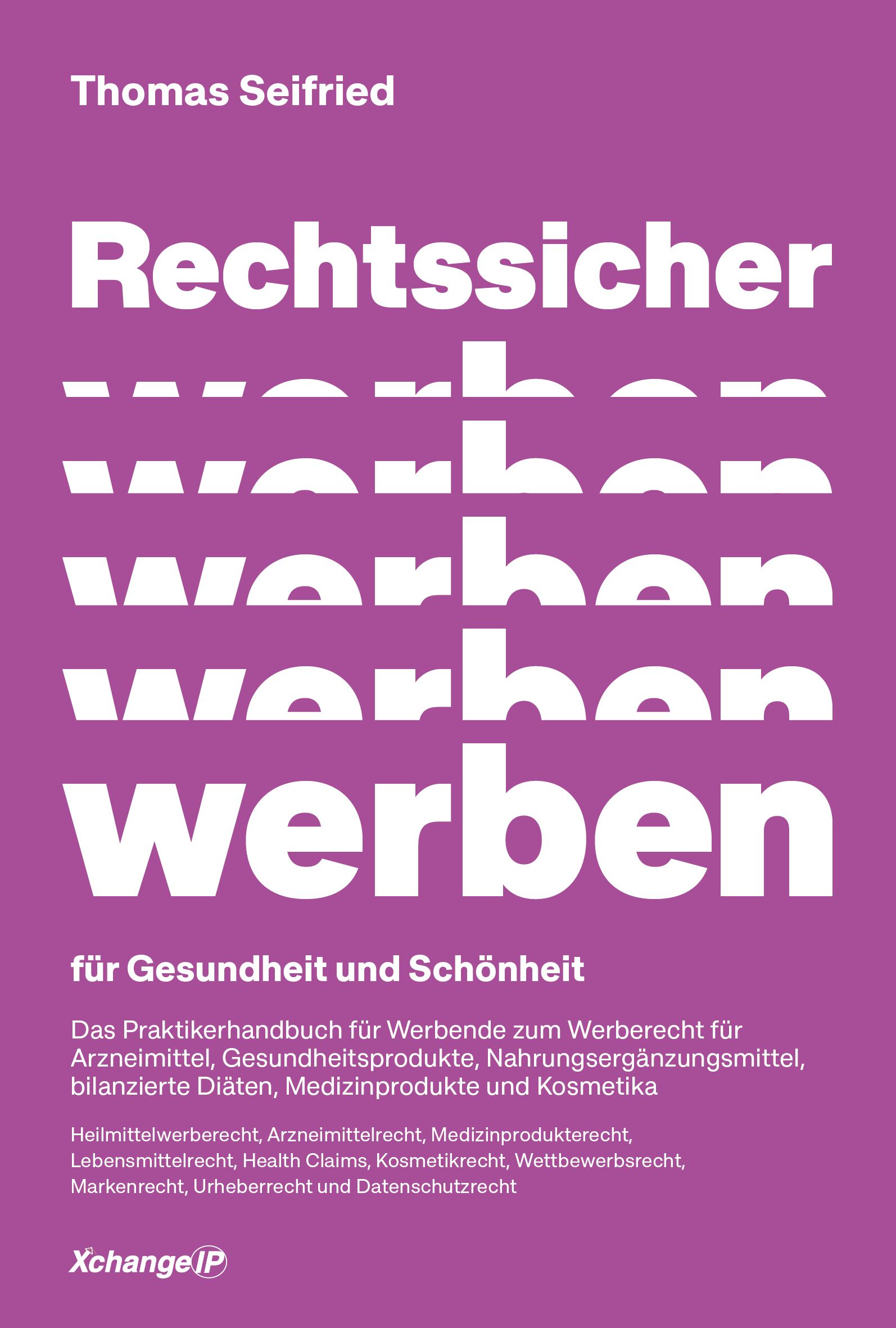
Advertising for health-related products is subject to particularly strict legal regulation. Courts set high standards for health-related claims. Advertising for medicines and other remedies, medical devices, food supplements, foods for special medical purposes and cosmetics is also restricted by specific laws and regulations. The risk of cease-and-desist notices and legal disputes is particularly high for these products. This book sets out the current legal position using several hundred examples from case law.
Contents:
- Selection of terms, texts and media
- Advertising with Trademarks
- General principles of competition law, misleading and comparative advertising, advertising prices and discounts
- Search engine optimisation and search engine advertising, social media and influencer marketing
- General requirements for health-related advertising
- Prohibitions and restrictions under medicines advertising law
- Advertising for medicinal products, pharmaceutical price controls, and advertising discounts and benefits
- Advertising medical devices
- Advertising food supplements, especially HEALTH CLAIMS
- Advertising for foods for special medical purposes
- Advertising for cosmetic products
Back to table of contents
1st edition, November 2024, 408 pages, XchangeIP Verlag, available from bookshops or Amazon
ISBN 978-3-00-079406-3
Misleading medicinal product names under Section 8 AMG
Under Section 8 AMG, the manufacture or marketing of medicinal products with misleading names is prohibited. Marketing also includes advertising (Section 4(17) AMG). Given the importance of health as a protected legal interest and the health risks associated with false expectations of medicinal products, the “strict principle” requires medicinal product names to be particularly truthful, unambiguous and clear (Münster Higher Administrative Court, 17 Jun 2013 – 13 A 1113/11; Federal Court of Justice, 6 Feb 2013 – I ZR 62/11 – Basal Insulin with Weight Benefit).
Misleading medicinal product names under an umbrella-brand strategy
For names, brands or designations of goods made up of several components, consumers often attach particular importance to the main component—typically the first part of the name—in determining the type or quality of the product. If the main component of a multi-part name is an umbrella brand that has been used for certain medicines for several years, consumers familiar with a product under that brand may perceive a (new) medicine bearing the same main name as having a similar indication and therapeutic effect, and may therefore be misled.
Example (Higher Administrative Court of Münster, 17 June 2013 – 13 A 1113/11; see also Higher Regional Court of Frankfurt am Main, 22 May 2020 – 6 U 23/20 – medicinal product by presentation)A manufacturer has marketed various dermatological medicines under a single umbrella brand for decades. Their sole active ingredient is an antihistamine. The manufacturer also markets a medicated cream for cold sores, whose sole active ingredient is the antiviral agent penciclovir. The Federal Institute for Drugs and Medical Devices (BfArM) refused to allow the cream to use the umbrella brand, on the grounds that using the same umbrella brand for a product with a different active ingredient would be misleading. Consumers encountering the new name would, in significant numbers, assume based on the umbrella brand that the medicine had therapeutic effects at least similar to those of the other antihistamine products. In fact, there was no such similarity. While most products under the umbrella brand contain an antihistamine to combat allergic reactions, the cold sore cream contains only the antiviral agent penciclovir.
Author: Thomas Seifried, Attorney-at-law specialising in trade mark law and Certified Specialist Lawyer for Intellectual Property Law
Trademark cease-and-desist letter concerning pharmaceutical trademarks
Cease-and-desist letters from trademark owners, competitors or trade associations
Use of medicinal product trademarks that infringe earlier trademark rights may be challenged by the holders of those rights. Use of misleading medicinal product names, in turn, may be challenged by competitors, qualified trade associations (e.g. Verband Sozialer Wettbewerb e.V. or Wettbewerbszentrale) and qualified entities through cease-and-desist letters under competition law and applications for interim injunctions. The details matter. Get in touch.
Author: Thomas Seifried, Attorney-at-law specialising in trade mark law and Certified Specialist Lawyer for Intellectual Property Law
Thomas Seifried, specialist lawyer for intellectual property law
Trademark lawyer Thomas Seifried has over 20 years’ experience in trademark law, with numerous notable successes, and has also been a specialist lawyer for intellectual property law since 2007. He has advised and represented businesses in the healthcare and cosmetics sectors for many years.